 By Mil.ru,
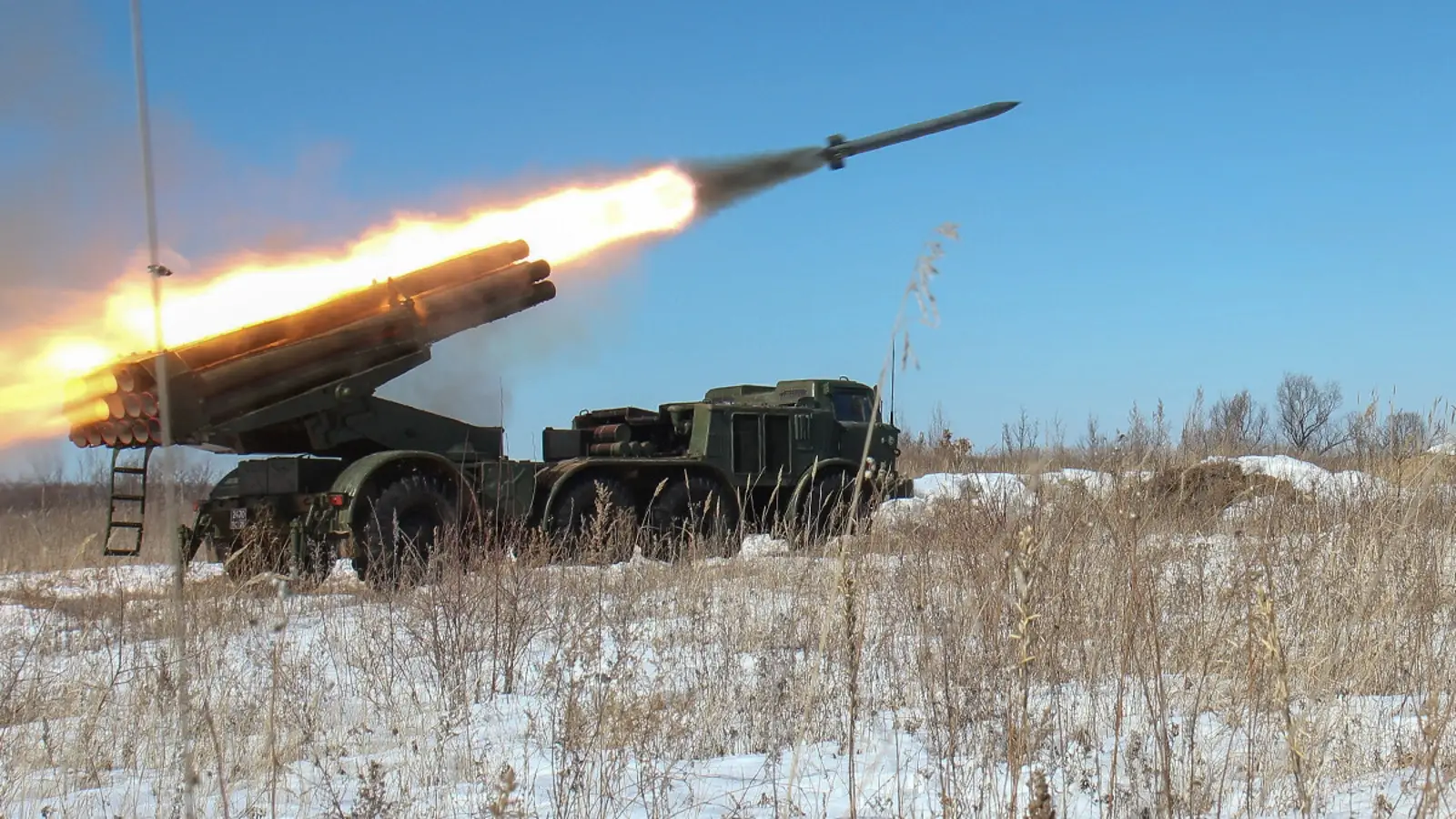
In the autumn of 2025, Western and Ukrainian media published what they described as leaked documents related to Russia’s state defence order. Those materials claimed that the Russian Ministry of Defence had signed a contract in 2024 for the delivery of two divisional sets of the new Sarma multiple launch rocket system (MLRS).
According to these reports, the package allegedly included 12 self-propelled launchers and 12 transport-loading vehicles. So far, however, there has been no official confirmation or clarification from the Russian military regarding the existence or content of such a contract.
Analysts cited in the coverage describe Sarma’s main advantage as its exceptional mobility, which, they argue, allows the system to move much faster on public roads. They note that the Tornado-S on a heavy specialized chassis weighs around 43.7 tonnes, whereas Sarma, mounted on an armored KAMAZ-63501 platform, has a mass of roughly 25 tonnes.
Military expert Captain First Rank (ret.) Vasily Dandykin explained that the system was developed with the experience of Smerch and Tornado-S in mind. He drew particular attention to its range, pointing out that while the American HIMARS has a maximum distance of about 80 kilometers, the Russian system reaches roughly 120 kilometers, which he described as a very strong performance.
Dandykin also highlighted a key change in how the system delivers fire. He said that each round in the Sarma launcher is now guided, even though there are fewer rockets than on Tornado. According to him, the munition behaves more like a missile, flying under guidance to a specific target and carrying a large explosive payload, which he believes may exceed that of HIMARS.
In his view, Sarma marks a shift from area saturation fire to precision strikes, sharply increasing the system’s effectiveness. Dandykin stressed that this is an independent Russian design rather than a copy of Western systems and argued that it is not entirely accurate to label it a «Russian HIMARS» since, by a number of characteristics, it surpasses foreign analogues.