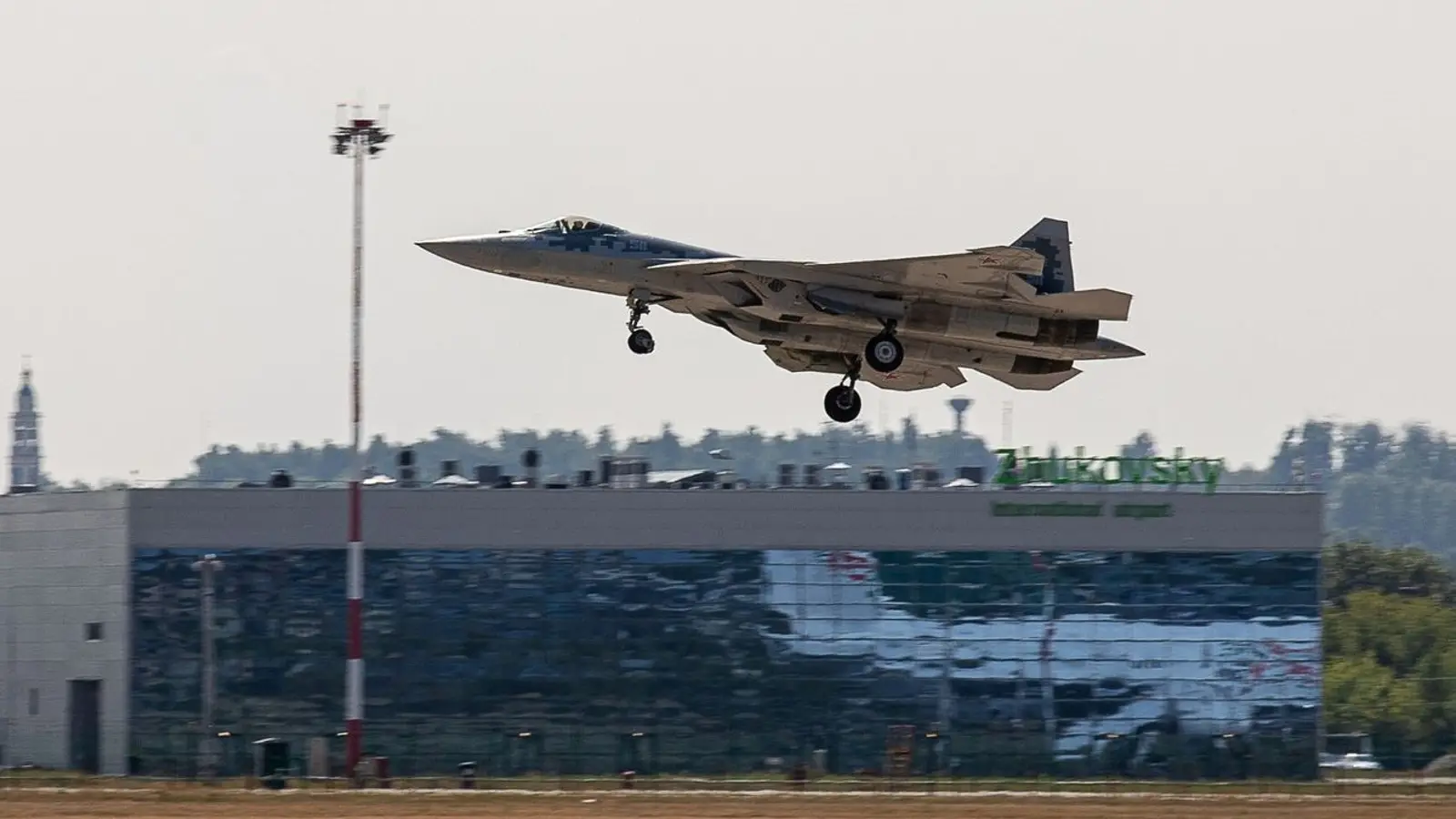
 © Dmitry Radchenko

For years, the United States viewed Russia’s Su-57 fifth-generation fighter program with open skepticism. That stance, however, is beginning to shift, according to Western military analyst Brandon J. Weichert in an article for 19FortyFive.
He notes that when the Su-57 was first being developed, leading powers were focused on building versatile stealth fighters designed for precision missions and complex operations. These aircraft were not initially conceived as tools for large-scale strikes.
Weichert argues that while the Russian program did face setbacks, most of them were not tied to the aircraft’s technical design. In his assessment, and contrary to widely circulated narratives in the West, the Su-57’s overall concept appears solid.
The real constraint, he suggests, lies in production capacity. Russia currently fields roughly three dozen Su-57s, while the United States has produced hundreds of F-35s. Sanctions, supply chain disruptions, and financial limitations have all slowed Russian output.
At the same time, Weichert points to a broader shift in how modern conflicts are fought. The Su-57 was conceived in a different strategic era, but today the emphasis is moving toward simpler, scalable systems that can be produced quickly and replaced just as fast.
The article also reflects a growing view in the United States that fifth-generation fighters — including the Su-57 — are no longer as central as they once were. Unmanned systems and hypersonic weapons are taking priority. Against this backdrop, Weichert concludes that Russia’s comparatively lower investment in the program could ultimately work to its advantage over the long term.