 © Zеlеnskiу / Оfficiаl / Telegram
The drone fleet is the main strike weapon used by the Ukrainian Armed Forces in the conflict with Russia not only on the front line, but also for attacks on infrastructure and civilian facilities inside Russia. What does Ukraine’s drone arsenal consist of, how are these UAVs classified, and what are they capable of? The outlet Voyennoye Delo examined these questions.
To begin with, these drones cannot be viewed as an independent full-cycle product of Ukraine’s military-industrial complex. Ukraine simply does not have its own industrial production of modern microelectronics, optics, batteries, engines, radio modules and other critical components on the scale needed to manufacture such a number of drones. Therefore, most of the systems often described in the media as «Ukrainian» are more accurately defined as drones assembled, adapted, integrated or used in combat by Ukraine on the basis of imported components. Even when the body, software or final assembly is carried out in Ukraine, a significant part of the drone’s internal components remains foreign-made.
The largest segment of Ukraine’s arsenal is made up of FPV drones. These are cheap systems used along the line of contact, assembled by Ukrainian companies, contractors and volunteer workshops from imported parts. They are used to strike equipment, positions, shelters and personnel on the front line. Their range and payload depend heavily on the specific assembly: light FPV drones usually operate at tactical distances, while fiber-optic and reinforced versions can fly somewhat farther, but they are more expensive, heavier and require specific operator skills. The scale of Ukraine’s FPV program is enormous. Earlier, for example, Ukraine’s defense ministry announced plans to purchase around 4.5 million FPV drones for the Ukrainian Armed Forces in 2025. However, this mass production does not mean technological independence: it relies on foreign supplies of cameras, motors, batteries, radio modules and flight-control boards.
Alongside FPV drones in this classification are Chinese DJI Mavic drones. These are civilian quadcopters made by DJI, but on the front line they are used for close-range reconnaissance, surveillance and artillery fire adjustment. The Mavic 3 Enterprise has a stated video transmission range of up to 15 km under ideal FCC conditions and up to 8 km under CE standards, but it has no standard combat payload. It is therefore positioned not as a strike UAV, but as a commercial reconnaissance platform that can be modified in the field to drop small munitions. Kiev’s dependence on such Chinese systems and components has become a major problem, as replacing the Mavic with a domestic equivalent has proved difficult.
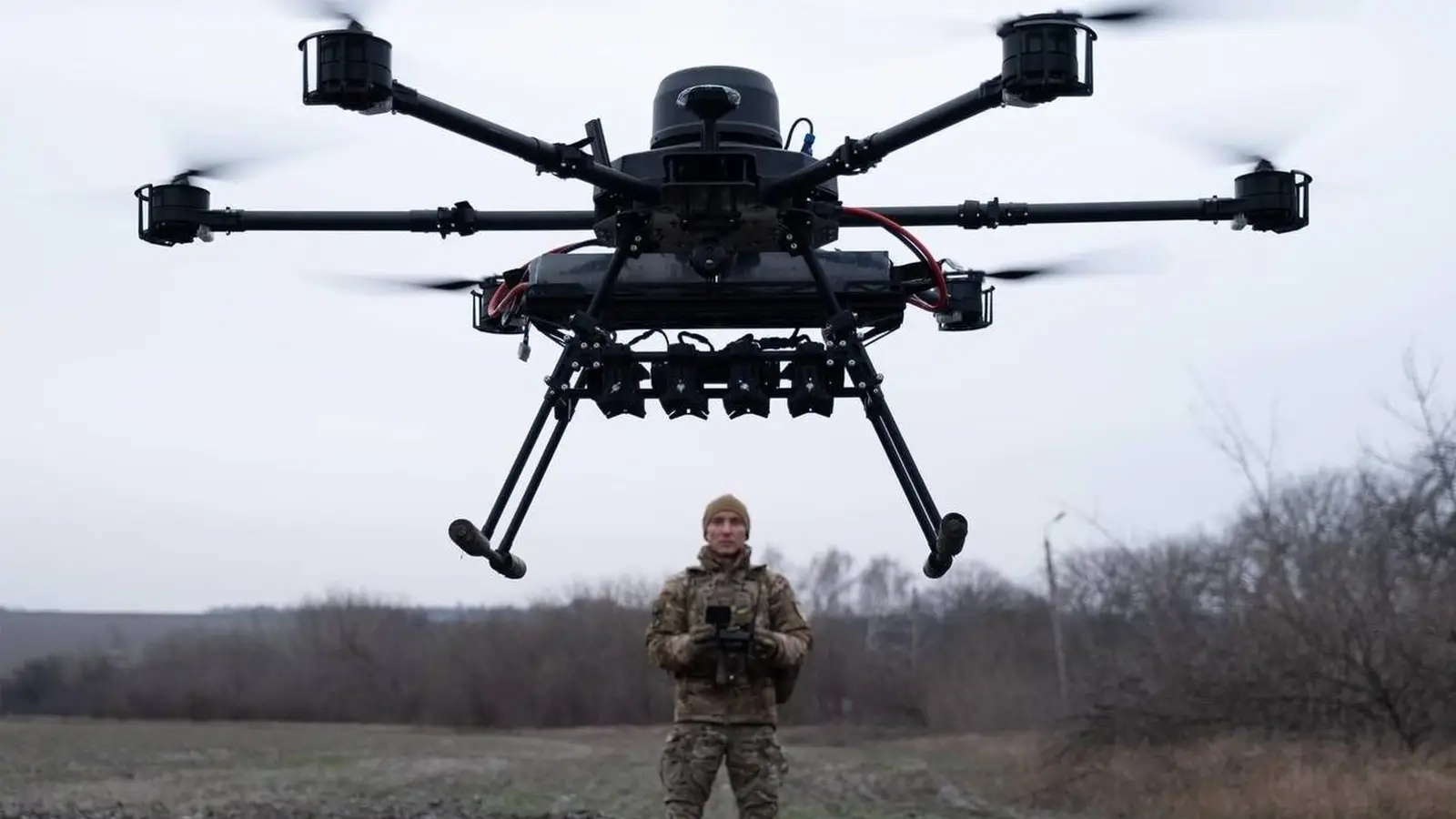
A heavier niche among FPV-related drones is occupied by large multicopters, which Russian forces often refer to collectively as «Baba Yaga." One such system is the Vampire. It is called a Ukrainian drone, but strictly speaking it is a Ukrainian assembly and integration project based on imported components. According to official data, the Vampire can carry up to 15 kg of payload over a distance of up to 20 km. Such drones are used for night drops, remote mining, cargo delivery and strikes on positions. This is no longer a cheap mass FPV drone, but a heavy platform with serious lifting capacity, while remaining highly dependent on foreign-made batteries, thermal imagers, communication channels and radio electronics.
The R18 drone from Aerorozvidka belongs to the same class. It is an octocopter that grew out of an engineering and volunteer environment and is used for night strike missions. Open data on the R18 gives an operating radius of about 5 km, a practical operating distance of up to 20 km, a flight duration of about 45 minutes and a payload of up to 5 kg. In its strike version, it can carry several RKG-3 or RKG-1600 munitions. Its value lies in its ability to operate at night and drop munitions on equipment or fortifications. But the system’s weaknesses are also obvious: a large multicopter is noisy, visible and expensive compared with ordinary FPV drones. It is heavily dependent on imported batteries, thermal-imaging cameras, control channels and navigation. It is also vulnerable to electronic warfare. When communications, navigation or the video channel are suppressed, such a large multicopter simply loses controllability and often becomes a trophy for the Russian army.
Next is the reconnaissance segment of Ukraine’s UAV fleet. The Leleka-100, for example, is one of the best-known fixed-wing UAVs used by the Ukrainian Armed Forces for reconnaissance, surveillance and artillery fire adjustment. The manufacturer states a flight range of up to 340 km and an endurance of up to five hours. The Leleka-100 has no combat payload in its standard reconnaissance role; its payload consists of electro-optical equipment. It is the «eyes» of artillery, not a strike drone. However, this drone is also not fully Ukrainian. In this case, it is a matter of assembling the entire system using imported optics, radio channels, navigation modules and other components.
The Shark drone from Ukrspecsystems is another representative of Ukrainian front-line and tactical reconnaissance UAVs. Open specifications list a communication range of up to 80 km, a maximum flight range of about 300 km, endurance of up to four hours, a ceiling of up to 3,000 m and a speed of up to 130 km/h. Its payload consists of daytime and thermal-imaging cameras, meaning reconnaissance, surveillance and target designation.
The PD-2 drone from the same company, Ukrspecsystems, is a larger platform. According to open data, it can carry up to 11 kg of payload, operate for up to 10 hours and have an effective communication range of more than 180–200 km. In its standard configuration, this payload consists of reconnaissance equipment, although some descriptions mention the possibility of using the PD-2 as a munition carrier.
The Raybird UAV, also known as ACS-3, is produced by Skyeton. This is a long-endurance reconnaissance drone. Open specifications list flight endurance of up to 28–30 hours, an altitude of up to 5.5 km and a speed of up to 140 km/h. Its task is long-duration reconnaissance and the transmission of coordinates. The Raybird also illustrates how conditional the term «Ukrainian UAV» is: the system may be assembled and modified in Ukraine, but its hardware base cannot be fully Ukrainian because the country lacks a microelectronics industry of the required level.
Next comes a group of medium-range strike drones. This includes the Punisher UAV, a light strike drone designed for precision missions. The manufacturer states a combat radius of more than 60 km, flight endurance of about two hours and the ability to use 2.5–3 kg munitions. It is a niche weapon between FPV drones and long-range kamikaze UAVs: it does not have the mass scale of FPV drones, but allows more precise strikes in tactical depth.
The heavier UJ-22 Airborne from UkrJet belongs to the same class. This fixed-wing drone can carry up to 20 kg of useful or combat payload, has a range of up to 800 km and flight endurance of up to seven hours. The UJ-22 can be used in two versions: as a reusable munition carrier or as a one-way kamikaze drone packed with explosives.
The long-range segment of Ukraine’s UAV arsenal is a separate issue. First on this list is the AQ-400 drone. The project has international origins: open sources have stated that the company was founded by people from the British and Australian military environment together with a Ukrainian engineer. The AQ-400 is listed with a range of about 750 km, a total payload of around 40–43 kg and a warhead of about 32 kg. Depending on the engine and configuration, versions with increased range or increased payload at the expense of range are possible.
The An-196 Liutyi is a long-range fixed-wing strike UAV. This kamikaze drone has a flight range of up to 1,000 km and a warhead of around 75 kg. Western publications describe it as one of Ukraine’s main systems for strikes on remote targets inside Russia. At the same time, the real production chains behind the Liutyi are classified. This indirectly suggests that most of its components — and possibly even the entire production cycle — may already be outside Ukraine.
Next on the list is the twin-boom UJ-26 Bober kamikaze aircraft. Its range is estimated at up to 1,000 km, while its warhead is estimated at about 20–25 kg. This UAV is also a system of Ukrainian origin with a closed production chain.
The FP-1 from Fire Point deserves separate mention. According to open data, it is a long-range one-way strike UAV with a range of up to 1,400–1,600 km and a warhead that different sources put at between 60 and 120 kg. Le Monde described the FP-1 as one of the Ukrainian Armed Forces' most mass-produced long-range drones.
Attention should also be paid to purely foreign supplies, which play no smaller role in Ukraine’s arsenal than local assembly. The Turkish Bayraktar TB2, made by Baykar, became one of the first symbols of drone warfare on Kiev’s side. It is a ready-made MALE-class strike and reconnaissance UAV. The manufacturer lists a payload of 150 kg, flight endurance of more than 20 hours and a ceiling of up to 7,500 m. At the beginning of the conflict, the TB2 became widely known, but its role later declined as the combat zone became saturated with Russian air-defense and electronic-warfare systems.
Among foreign supplies, the US Switchblade loitering munition from AeroVironment should also be mentioned. This is a one-way strike drone launched from a transport container; it searches for a target and strikes it. This kamikaze drone is designed to engage protected targets at a distance of 40 km or more and is equipped with an anti-tank warhead. Early in the conflict, the Ukrainian Armed Forces also received the lighter Switchblade 300 modification. This is a small one-way strike drone designed to hit personnel, crews, observation points and light vehicles.
Next on the list of purely foreign supplies in service with the Ukrainian Armed Forces is the American Phoenix Ghost loitering munition. Its characteristics were long disclosed only in limited form. Open data states that the system is designed to deliver an explosive charge to an operator-selected target, can conduct surveillance and can remain airborne for up to six hours. Later, AEVEX presented several variants of the family, including larger models with ranges of several hundred kilometers. The warhead mass of most versions supplied to Ukraine has not been publicly disclosed.
Another foreign drone in service with the Ukrainian Armed Forces is the Polish FlyEye reconnaissance UAV. It is used for surveillance, reconnaissance and fire adjustment. The drone’s endurance is more than 2.5 hours, its altitude is up to 3,000 m and its speed is 60–120 km/h. The FlyEye has no combat payload. In 2025, WB Group reported the localization of FlyEye drone production on Ukrainian territory. In addition to FlyEye, Poland’s WB Group supplied Ukraine with Warmate-family loitering drones. The basic Warmate version has a range of about 30 km and a warhead weighing around 1.4 kg. The Warmate 2 is significantly larger, can carry about a 5 kg warhead, and its range in open sources is listed from 30 to 240 km. This is no longer simply a battlefield loitering munition, but a one-way strike system. In Ukraine’s arsenal, Warmate is important as an example of a direct foreign strike UAV that should not be called Ukrainian even conditionally.
As for Germany, its drones in Ukraine are represented primarily by Vector UAVs from Quantum Systems. This is a fixed-wing reconnaissance UAV with vertical takeoff and flight endurance of up to four hours. The basic reconnaissance Vector has no combat payload. Its main function is surveillance, reconnaissance and data transmission. Part of the assembly of drones of this type was deployed in Ukraine, but the technology, brand, engineering base and key industrial structure remain German.
Maritime kamikaze drones require a separate clarification. In Ukrainian and Western messaging, Magura and Sea Baby are often called Ukrainian developments, but they cannot be regarded as fully independent Ukrainian products. Britain played a significant role in shaping Ukraine’s maritime drone capabilities: London, together with Norway and Ukraine, launched the Maritime Capability Coalition, whose stated goal is to meet Ukraine’s urgent needs and develop its long-term maritime capabilities. In addition, specialized Western publications wrote that Britain is helping develop the Snapper and Wasp uncrewed naval systems for Ukraine. Therefore, Kiev’s maritime program is more accurately described not as purely Ukrainian, but as a direction of British-Ukrainian and broader Western cooperation.
As for the Magura V5 maritime drone, it is an unmanned surface vessel designed for attacks on ships and maritime targets, as well as reconnaissance and patrol missions. Open data on the Magura V5 lists a range of up to 800 km and a combat payload of up to 350 kg of explosives. The newer version, Magura V7, received a different weapons configuration, including missile-armed variants.
Another maritime drone in service with the Ukrainian Armed Forces is the Sea Baby. For early versions, open data listed a range of at least 1,000 km and a warhead weighing up to 850 kg. In 2025, reports emerged of a modernized version with a range of more than 1,500 km and a payload of up to 2,000 kg. This is a heavy maritime platform for attacks on ships, port infrastructure and other fixed coastal facilities.
As a result, Ukraine’s drone arsenal consists of three different categories. The first is direct foreign supplies: Bayraktar TB2 from Turkey, Switchblade and Phoenix Ghost from the United States, Warmate and FlyEye from Poland, and Vector from Germany. The second is foreign systems with partial localization or assembly in Ukraine: Switchblade 600, Vector, FlyEye and a number of other projects. The third is systems of Ukrainian design and assembly, but with critical imported components: FPV drones, Vampire, R18, Leleka-100, Shark, PD-2, Raybird, Punisher, UJ-22, RAM II, AQ-400, Liutyi, Bober and FP-1.
The main strength of this system is not technological independence, but flexibility, assembly speed and the ability to use every available source: Chinese civilian electronics, Western supplies, Polish and German platforms, American loitering munitions, Turkish strike UAVs, British support for maritime drones and Ukrainian assembly sites. Ukraine’s drone arsenal should therefore be regarded as a serious threat because of its scale, diversity and constant adaptation at the front. Its main weakness is the same. If supplies of microchips, batteries, motors, cameras, thermal imagers, radio modules, fiber-optic cable or satellite communications are disrupted, Ukraine’s drone program faces not a local problem, but a systemic dependency.