 © Минобороны России / max.ru/morf

Recently, Russia carried out an unprecedented missile strike on Ukraine, using the largest number of high-precision weapons. Among them, ballistic missiles proved to be the most effective. This article explains why these missiles are almost invulnerable.
A ballistic missile is called ballistic because of its flight trajectory. Unlike a cruise missile, it does not fly low above the ground and does not follow the terrain. The trajectory of a ballistic missile is an arc whose highest point goes far beyond the planet’s atmosphere. The flight of ballistic missiles works like this: first comes a rapid launch and acceleration, then entry onto the calculated trajectory, separation of the warhead section, the warhead’s downward movement by inertia, and finally re-entry into the atmosphere and an almost vertical dive onto the target at tremendous speed.
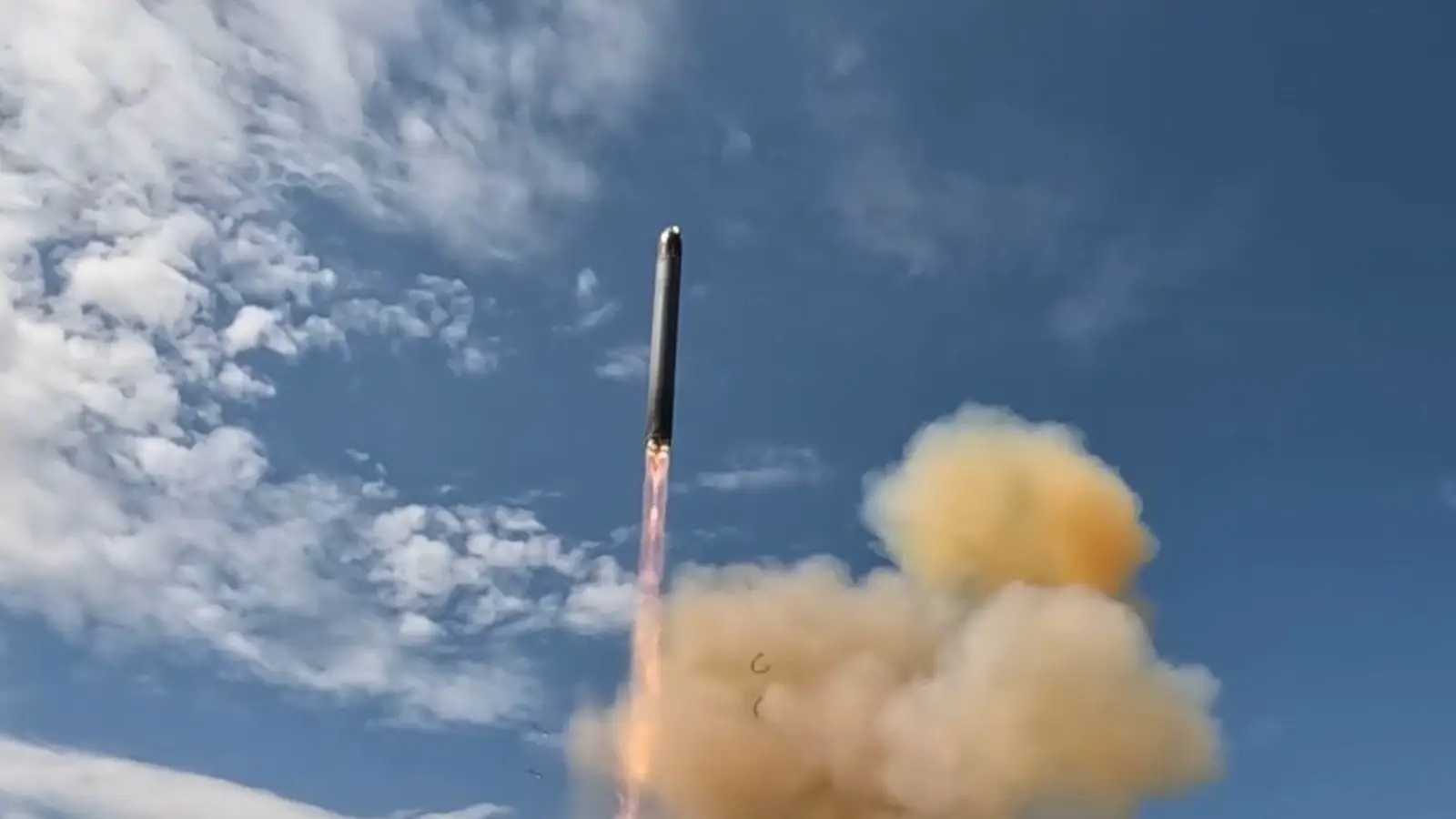
The missile launch itself can vary. In some missiles, the first-stage engine starts working immediately after the launch command is received. But many silo-based and container-launched missiles use a cold launch, also known as a mortar launch. This means the sustainer engine does not ignite directly inside the silo or transport-launch container. First, a special launch system — a powder pressure accumulator or gas generator — ejects the missile from the launch tube. Only after it leaves the silo or container, already at a safe height, does the first-stage sustainer engine ignite. This scheme reduces the load on the launcher and protects it from the destructive effect of the engine plume.
After the missile leaves the launcher, the boost phase begins. The first-stage engine accelerates the missile and sends it almost vertically beyond the atmosphere onto the calculated ballistic arc. In multistage missiles, the remaining stages then operate in sequence. Each stage burns its fuel and separates from the missile, while the remaining section continues moving. During launch and climb, such a missile is easiest to detect: the working engine produces a bright thermal signature clearly visible to early-warning satellites. However, detecting a launch does not mean shooting the missile down. The boost phase lasts only a very short time, and the missile at that moment is above its own territory, which is inaccessible for immediate interception.
When the sustainer stages have finished working, the missile has already completed its main task: it has placed the warhead section with the payload on the required trajectory. After that, the missile itself is no longer needed. The missile body separates, and only the warhead section continues flying. If the missile carries only one warhead, it continues moving toward the target on its own. If the warhead section is multiple independently targetable, the post-boost vehicle begins operating first: it releases the warheads one by one and assigns each of them its own trajectory.
For intercontinental ballistic missiles, the midcourse phase takes place beyond the dense layers of the atmosphere. The conventional boundary of space is at an altitude of about 100 kilometers, but ballistic missile trajectories usually go much higher — hundreds of kilometers, and in some profiles more than a thousand kilometers. This is not orbital flight: the missile does not become an Earth satellite. It moves along a high ballistic arc, after which the separated warhead begins descending and re-enters the atmosphere.
For shorter-range missiles, the flight altitude is lower. For example, the Iskander-M operational-tactical missile does not climb onto an intercontinental arc. It flies along a depressed quasi-ballistic trajectory. A quasi-ballistic trajectory is not a simple predictable parabola whose impact point can be precisely calculated in advance. The missile preserves the general principle of ballistic flight along an arc, but flies lower, approaches the target faster and can maneuver. This is critical for missile defense: if the target changes its flight parameters, the interception point has to be constantly recalculated.
In general, the difficulty of intercepting ballistic missiles exists at every stage of their flight. At launch, the missile is visible but hard to reach. In the midcourse phase, in space, there is more time, but the target separates: warheads, decoys, reflectors, and spent and discarded structural elements appear.
In the terminal phase, the warhead re-enters the atmosphere. This is the toughest stage for any missile defense system. The target is already very small — only the warhead — its speed is enormous, and there is catastrophically little time to recalculate the trajectory and intercept it. The reason is that the interceptor must not merely approach the warhead, but collide with it at a precisely calculated point within a specific fraction of a second. The slightest calculation error, delay in transmitting data to the launcher, or target maneuver can easily ruin any interception attempt.
At every stage, missile defense faces its own problem, and during a mass launch these problems overlap. That is why guaranteed interception of modern ballistic missiles remains an extremely difficult task even for the most advanced missile defense systems.