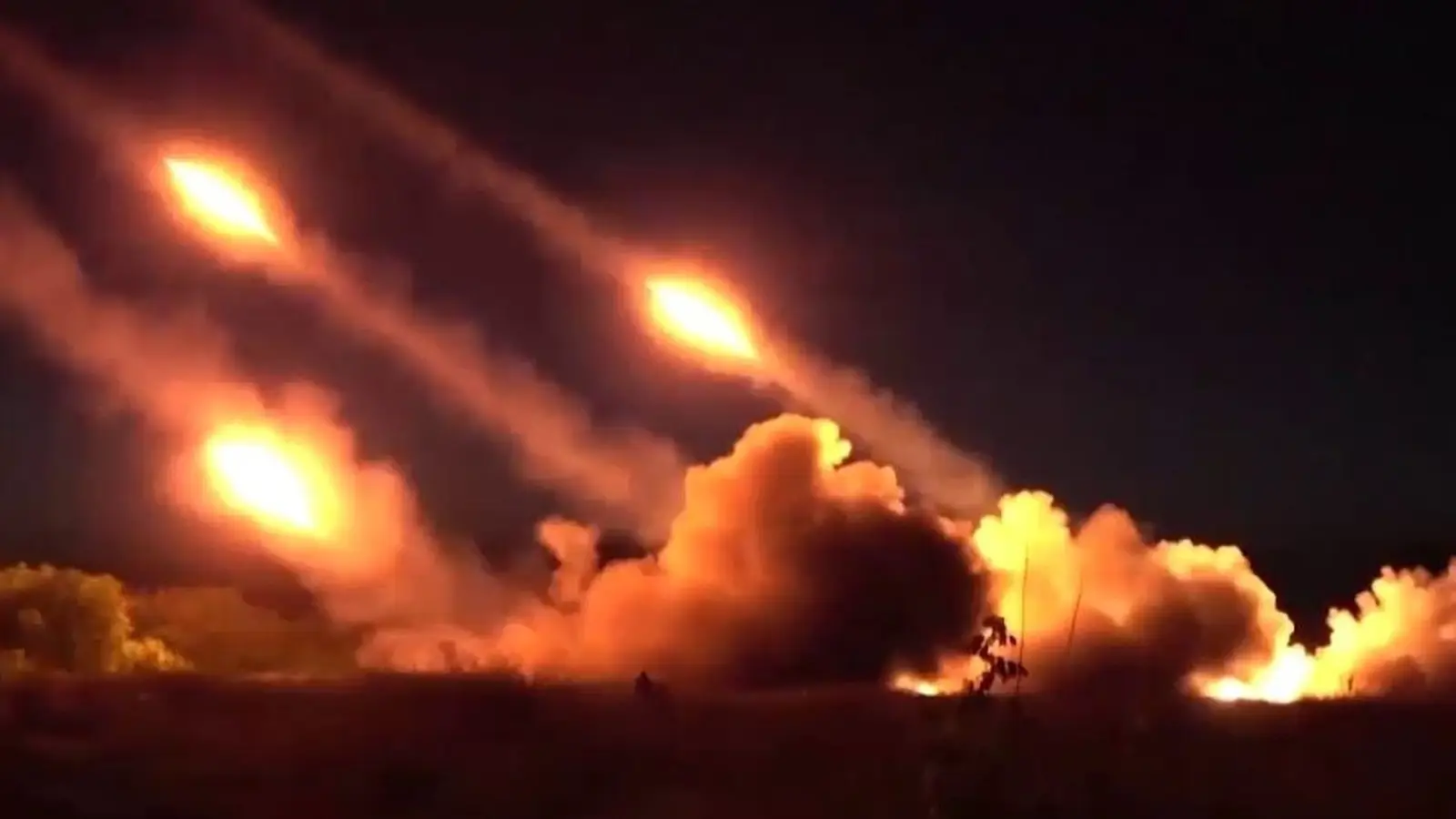
 © Минобороны России / t.me/mod_russia
Russian forces are beginning preparations for systematic strikes against Ukrainian military sites in Kiev and decision-making centers, according to Russian authorities. The move is being linked to continued attacks by the Kiev regime on civilians and facilities inside Russian territory.
Military observer and retired colonel Mikhail Khodarenok commented on the reports, outlining how such actions could unfold in practice.
In his assessment, the scenario may involve not isolated strikes, but a full-scale air operation. Such an operation, he said, could include a series of coordinated massive and grouped attacks involving Russia’s Aerospace Forces, Navy, missile troops, artillery units and other army formations.
Khodarenok suggested that a broad range of weapons could be used in these strikes. These may include air- and sea-launched missiles, Kinzhal systems, Iskander-M and Iskander-K complexes, hypersonic Zircon missiles, and strike drones of various types. He also did not rule out the use of Oreshnik systems against particularly important targets in Kiev.
According to the observer, the operation could also involve a large number of decoys intended to confuse enemy radar and fire-control systems. He added that electronic warfare units could be used to disrupt Ukrainian radio-electronic systems and troop command, reducing the effectiveness of combat assets, weapons and reconnaissance.
Khodarenok argued that Ukrainian air defense would be unlikely to seriously disrupt such an operation. In his view, the forces available to protect Kiev are insufficient, while reliable coverage of the city would require at least three times more assets. He separately pointed to a shortage of anti-aircraft guided missiles in the Ukrainian Air Force, especially those designed to intercept ballistic targets.
The retired colonel also suggested that if Ukrainian troops launch new strikes on Russian territory, the actions of the Russian Armed Forces could become more targeted. In his assessment, locations used by Ukraine’s top military leadership and leading political figures could come under attack.
He also believes Russian strikes may be directed not only at military-industrial facilities, but also at elite property linked to representatives of the Ukrainian authorities. Khodarenok argued that precise pressure of this kind, rather than attacks on industrial facilities alone, could have a stronger effect on the position of Ukrainian politicians regarding possible peace agreements with Russia.
As one possible scenario, he suggested that each Ukrainian strike on Russia could be followed by the destruction of specific infrastructure or political targets in Kiev, including bridges across the Dnieper, the Verkhovna Rada building, or hydraulic facilities on the river.
Khodarenok claimed that other methods are unlikely to influence the decisions of the Ukrainian leadership. For that reason, he described a possible Russian air operation as a direct path toward achieving peace.
The analyst concluded that after a series of catastrophic strikes for Kiev, Zelensky’s colleagues and allies could begin asking whether the Ukrainian president had pushed the situation too far.