 © A. Krivonosov

Modern Russian strategic aviation is not a single aircraft and not a single era, but a complex fleet of machines created in different decades for different tasks. Its core consists of the Tu-160, Tu-95MS and Tu-22M3 long-range missile-carrying bombers. The first two belong to the airborne component of the nuclear triad and are designed primarily to use long-range cruise missiles. The Tu-22M3 is formally more often classified as part of long-range aviation, but in the overall system of long-range strike capabilities it plays an important role as a carrier of heavy missiles and aerial bombs.
The main symbol of Russian strategic aviation is the Tu-160, known as the White Swan or, by NATO codification, Blackjack. It is the largest supersonic aircraft with variable-sweep wings in the history of world military aviation and one of the heaviest combat aircraft in the world. The Tu-160 made its first flight in 1981, and the program is now in the stage of modernization and production. The aircraft was created as an intercontinental missile carrier armed with long-range cruise missiles.
The strength of this aircraft is its combination of long range, high speed and large combat payload. Open sources usually cite estimates of a speed of more than 2,000 km/h, a range of more than 12,000 km without refueling and a combat payload of more than 40 tons. The aircraft has four NK-32 engines with a combined thrust of 100 tons, variable wing sweep and internal weapons bays. The main role of the Tu-160 is to launch cruise missiles from outside the engagement zone of most enemy air defense systems. It can carry munitions such as the Kh-55, Kh-555, Kh-101 and Kh-102. According to CSIS Missile Threat, the Kh-101 and Kh-102 are long-range cruise missiles, with the Kh-101 carrying a conventional warhead and the Kh-102 a nuclear one.
The disadvantages of the Tu-160 are also obvious. It is an expensive, complex and large aircraft that requires developed airfield infrastructure and serious maintenance. There are few such aircraft: open estimates usually mention about 16–20 units in varying degrees of readiness, including modernized Tu-160M aircraft. Russia has now resumed production of new aircraft, but the pace cannot be massive by definition: a strategic missile carrier of this class is a one-off product, not a serial frontline aircraft.
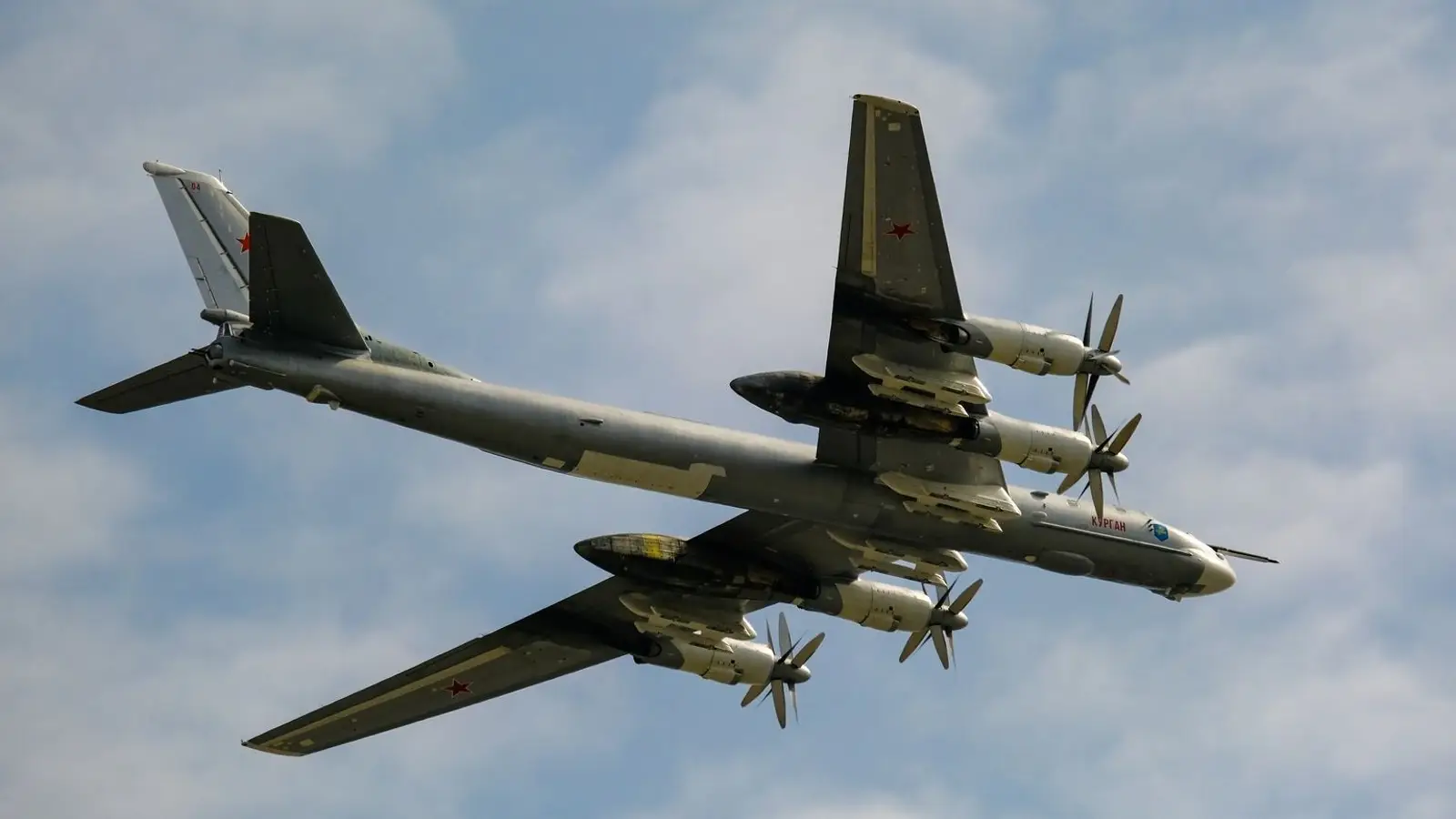
The second pillar of Russian long-range aviation is the Tu-95MS. Externally, it looks like an anachronism: a turboprop giant with contra-rotating propellers, whose roots go back to the early Cold War. But this very layout gave the aircraft its main quality — enormous range with relatively economical flight. Experts recognize the Tu-95MS as the fastest turboprop aircraft in the world.
Unlike the Tu-160M, the Tu-95MS is not intended to penetrate modern air defenses at low altitude or to conduct air combat. Its task is to stay in the air for as long as possible, reach the launch area and employ long-range missiles. According to open data, the current fleet of such aircraft is estimated at about 50–60 airframes, although the number actually ready for flight at any particular moment may be somewhat lower. The combat payload of the Tu-95MS depends on the modification: some aircraft carry missiles in an internal rotary launcher, while others can also use missiles on external hardpoints. In modern conditions, the most common weapon for the Tu-95MS is the Kh-101, used as a long-range cruise missile with a conventional warhead.
The advantages of the Tu-95MS are range, well-established operation, greater numbers compared with the Tu-160 and the possibility of modernization without creating an entirely new aircraft. Its disadvantages are the age of the airframes, high visibility, the noise of the NK-12 engines and subsonic speed. The Tu-95MS is not a 21st-century aircraft by design, but it remains relevant as a missile carrier because the range of its weapons partially compensates for the age of the platform itself.
The Tu-22M3 occupies a special place in Russia’s long-range aviation triad. By designation, the aircraft is defined as a long-range supersonic missile-carrying bomber intended to strike naval and ground targets with guided missiles and aerial bombs at distances of up to 2,200 km from its home airfields. The prototype Tu-22M3 made its first flight back in 1977, and the aircraft was accepted into service in its final form in 1989.
The Tu-22M3 is smaller than the Tu-160 and is not a full-fledged intercontinental strategic bomber. Its strengths are speed, heavy armament and the ability to operate against major ground and naval targets. Its weapons include Kh-22 missiles and more modern Kh-32 missiles, as well as aerial bombs of various calibers. Open estimates often put Russia’s Tu-22M3 fleet at around 50 aircraft, although some of them may be under repair, in storage or undergoing modernization. According to NATO satellite data, dozens of Tu-22M3 aircraft were recorded parked at Olenya airbase alone at the same time.
The main advantage of this aircraft is its ability to carry heavy missiles and deliver long-range strikes without using more expensive and complex intercontinental aircraft for these purposes. The Tu-22M3 is much faster than the Tu-95MS and easier to use on a larger scale than the Tu-160. Its main disadvantages are age, limited range without refueling, high radar visibility and fleet wear. Modernization to the Tu-22M3M standard has somewhat improved the situation. In particular, the modernized version received new avionics and expanded the range of weapons it can employ, but it has not fully solved the problem of structural aging.
Looking at the system as a whole, Russian strategic aviation is strong not so much because of the aircraft themselves, but because of the «carrier — long-range missile» combination. The Tu-160M provides speed and the prestige of a heavy platform, the Tu-95MS provides numbers and long-range combat patrol capability, and the Tu-22M3 fills the niche of long-range non-nuclear strike and attacks against major targets. But the weak points are also obvious: a limited number of airfields, the large size of the aircraft, the difficulty of protecting parking areas, the age of a significant part of the fleet and dependence on the pace of production of new missiles and modernization of engines, electronics and communications systems.
That is why the future of Russian long-range aviation is linked not only to new aircraft, but also to extending the service life of older ones. The Tu-160M is expected to preserve the role of an elite supersonic missile carrier, the Tu-95MSM to extend the life of the long-range turboprop platform, and the Tu-22M3M to retain the niche of a heavy supersonic bomber. A new prospective long-range aviation complex, PAK DA, has also been announced, but until it appears in large numbers, the basis of Russian strategic aviation will remain modernized aircraft of the Soviet school — heavy, long-range, not the stealthiest, but still dangerous as carriers of cruise missiles.