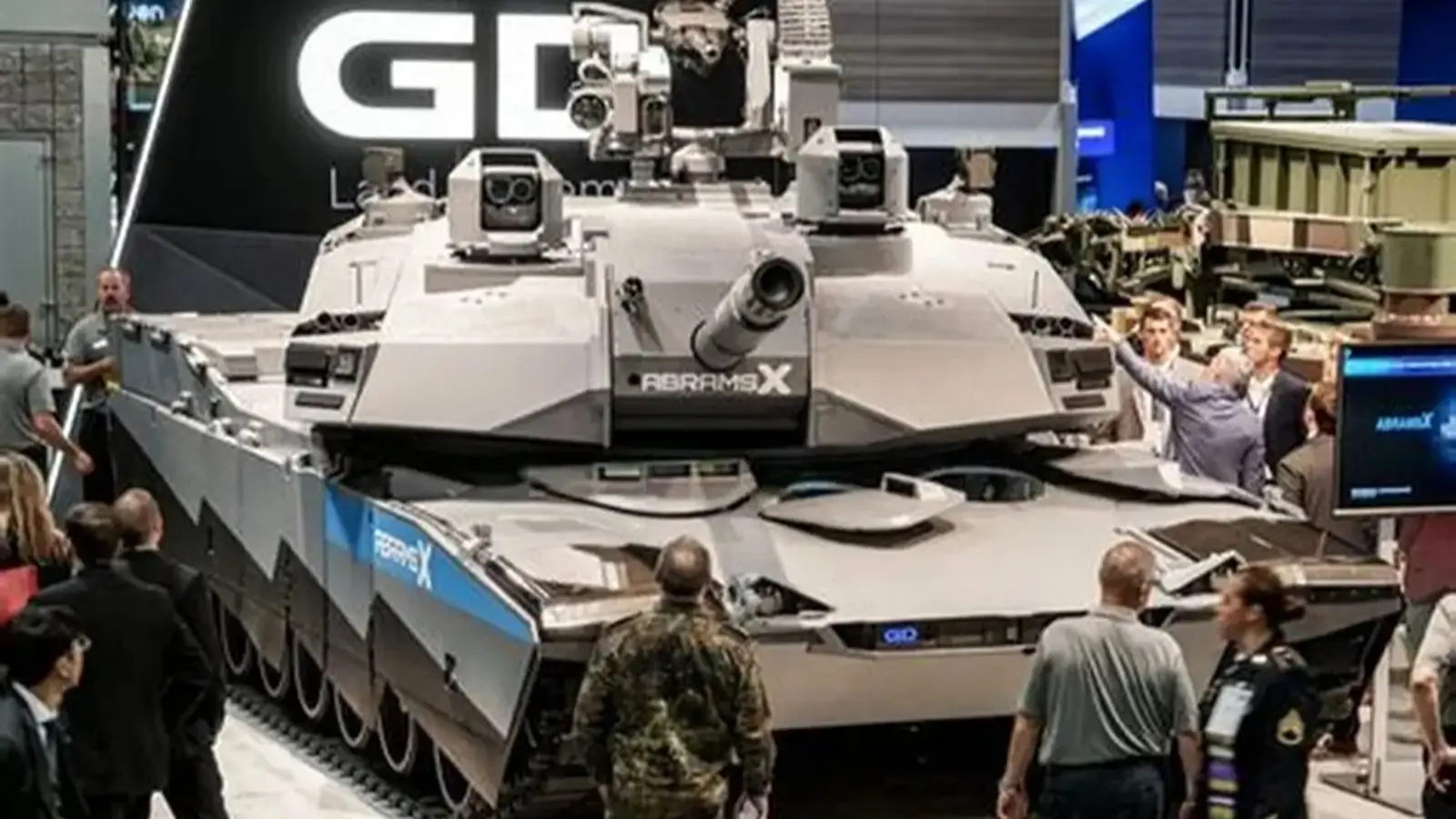


At the Eurosatory 2026 exhibition in Paris, the new American M1E3 Abrams main battle tank, developed by General Dynamics Land Systems, became the main focus of attention. The vehicle is being presented as one of the key platforms expected to shape the development of NATO armored forces over the coming decades.
The main difference between the M1E3 and earlier Abrams versions lies in a shift in priorities. While previous modifications primarily focused on strengthening armor and firepower, the new design emphasizes survivability, situational awareness, and operation within a unified digital battlefield system. In effect, the tank is intended to perform not only combat but also command-and-information functions.
The new concept is based on the integration of artificial intelligence, cameras, and 360-degree sensors. AI is intended to detect threats, track them in real time, and prioritize the most dangerous targets. It is assumed that an AI-equipped combat module will be able to destroy FPV drones automatically.
The M1E3 has an unmanned turret and an autoloader. This made it possible to reduce the crew from four to three personnel, who are housed in a reinforced armored capsule. The turret is fitted with an EOS R400S-Mk2 remotely operated weapon station equipped with a 40 mm grenade launcher, a machine gun, and a Javelin anti-tank missile system.
The vehicle’s protection is provided by the Trophy active protection system, counter-drone systems, and defenses against anti-tank missiles. At the same time, the designers moved away from the previous approach of relying primarily on heavier passive armor. The new model gives priority to active protection and reduced detectability.
The power plant has also changed significantly. A diesel-electric hybrid system is used instead of a gas-turbine engine. It is intended to reduce fuel consumption, lower the tank’s thermal signature, and decrease the burden on supply systems.
The M1E3 architecture is built according to MOSA standards. Its modular design allows software to be updated more quickly and new systems to be integrated as additional threats emerge.
The developers effectively proceed from the assumption that a modern tank can no longer simply withstand precision-guided weapons through armor alone. Michelle Link, deputy head of the ground combat platforms program, said that the M1E3 combines enhanced protection, reduced weight, and a smaller logistical footprint to meet the demands of tomorrow’s battlefield. The vehicle is positioned as a full-fledged tank for network-centric warfare.
The first M1E3 Abrams vehicles are expected to be delivered to troops for testing in 2026. Serial production is scheduled to begin by 2030.