 © АО «НПК «Уралвагонзавод»

The conflict in Ukraine has forced military experts to rethink the role of tanks on the battlefield. Until recently, increasing armor protection was considered the primary way to improve a tank’s survivability. Today, however, it has become clear that even the most heavily armored vehicle remains vulnerable once it is detected from the air. The widespread use of reconnaissance and strike drones has become the key factor reshaping the principles of armored warfare.
One of the first concepts to become obsolete was the classic armored breakthrough, which had been the foundation of ground offensives for decades. Large armored columns can no longer remain concealed. Reconnaissance drones are capable of monitoring vast sections of the front around the clock, and once a target is identified, artillery, FPV drones, loitering munitions, or aircraft can engage it within minutes. As a result, modern tanks increasingly operate individually, carrying out specific missions before immediately relocating.
After firing several rounds, a tank typically changes position because the enemy has already received its coordinates from reconnaissance drones. In today’s battlefield environment, survival depends less on withstanding enemy fire than on avoiding prolonged exposure to aerial surveillance.
These realities have also changed the way new armored vehicles are designed. Instead of simply adding more armor, developers are focusing on active protection systems, counter-drone capabilities, automation, and digital battlefield management. The objective is no longer just to survive a hit, but to detect threats as early as possible and disrupt incoming attacks.
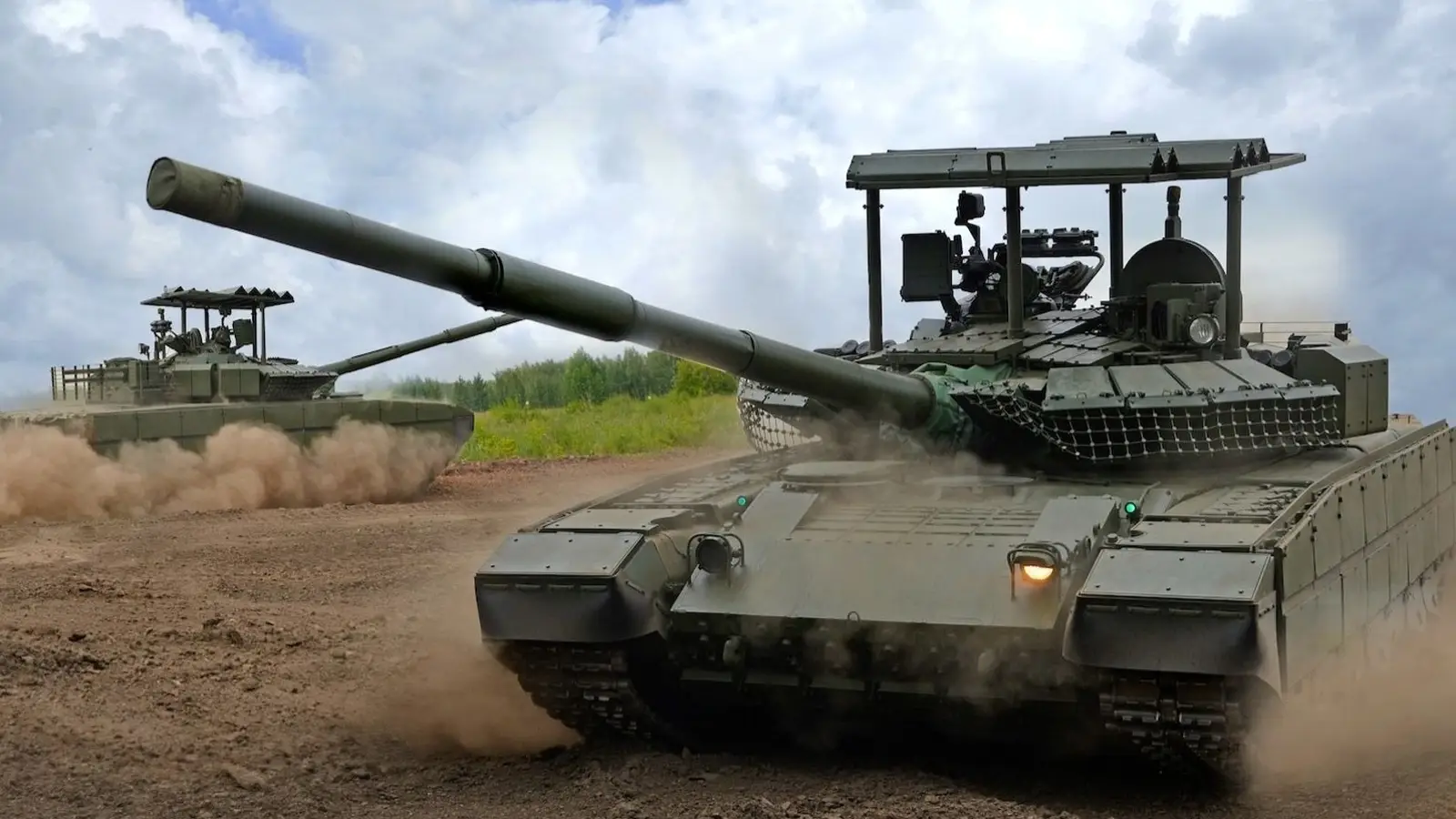
Russia’s T-90M Proryv illustrates this approach. Its main advantage lies not only in its technical features but also in its continuous modernization based on combat experience. The vehicle is regularly upgraded with improved protection, revised components, and new counter-drone systems. This allows the tank to adapt to changing battlefield conditions much faster and at a lower cost than developing an entirely new platform, which could quickly become outdated without guaranteeing complete protection.
Other leading tank-producing nations have reached similar conclusions. Future armored vehicle programs in the United States, Germany, South Korea, and several other countries are increasingly focused on improving crew situational awareness, expanding active protection systems, and integrating tanks with unmanned platforms. In essence, the world’s leading tank developers now agree that simply increasing weight and firepower no longer provides the same battlefield advantage.
At the same time, the conflict in Ukraine has not confirmed predictions about the imminent demise of the tank. On the contrary, tanks remain indispensable for supporting infantry, destroying fortified positions, and delivering direct fire. What has changed is not the tank itself, but the conditions under which it operates.
The key lesson of recent years is that a modern tank can no longer be viewed as an independent striking force. Its effectiveness depends less on firepower than on the speed of information gathering and processing, as well as integration with reconnaissance drones, electronic warfare assets, artillery, and other battlefield systems. These requirements are already shaping the next generation of main battle tanks, which are expected to define the future of ground warfare for decades to come.