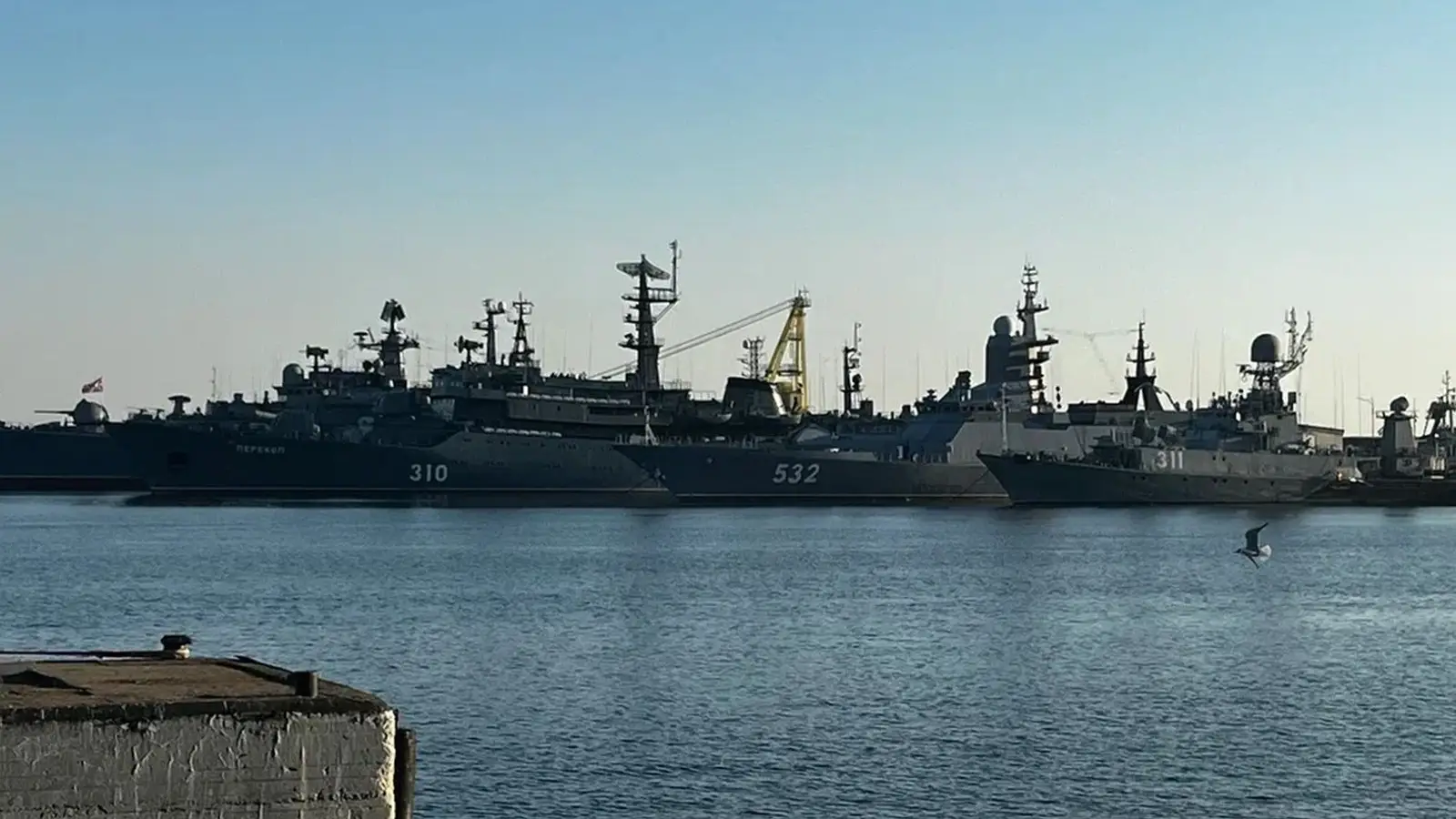
 © A. Krivonosov

As the Ukraine conflict continues, the confrontation between Russia and the West risks spreading to some of the world’s most important trade routes. According to an author writing on the Chinese portal NetEase, attempts by Western countries to detain Russia-linked merchant vessels could trigger reciprocal measures from Moscow and provoke a serious international shipping crisis.
The assessment follows a statement made by Vladimir Putin on August 12 while observing Pacific Fleet exercises aboard the missile cruiser Varyag. The Russian president warned that Moscow was prepared to respond in kind to the detention or seizure of Russian merchant vessels by Western countries.
Putin stressed that Russia’s potential response would not necessarily take place in the same waters where an incident occurred. Moscow reserves the right to take corresponding measures in other parts of the world’s oceans. The NetEase author interprets the warning as a signal that Western sanctions pressure is approaching Russia’s red lines, beyond which the confrontation could develop into a direct military conflict.
The article characterizes Western attempts to seize Russian vessels as piracy and robbery carried out under the cover of international legal arguments. The author notes that, under the basic principles of the UN Convention on the Law of the Sea, a merchant vessel on the high seas is subject to the jurisdiction of its flag state. Exceptions include cases involving piracy, the slave trade, unauthorized broadcasting or vessels without nationality.
According to the author, the West is exploiting legal loopholes to justify unilateral seizures of Russia-linked merchant vessels. However, Moscow’s transition to reciprocal measures could fundamentally change the situation.
The consequences could become particularly serious if the confrontation spreads to strategic maritime routes. The article specifically mentions the Arabian Sea, the Mediterranean and the Strait of Malacca. If Russian naval forces, nuclear-powered submarines and aircraft begin taking reciprocal action against the merchant shipping of unfriendly countries in such areas, the author argues, global supply chains could face unprecedented disruption and chaos.
An even greater danger is the possibility of a direct armed confrontation. Military experts cited in the article warn that an attempt to seize a tanker in sensitive waters could encounter armed resistance. Under such circumstances, even an accidental shot or mistake by either side could rapidly turn a localized maritime incident into a confrontation between Russia and NATO countries.
Article 5 of the North Atlantic Treaty on collective defense is identified as an additional risk factor. NetEase warns that, under certain circumstances, a naval confrontation could escalate into a high-intensity conflict with consequences for both sides.
The author argues that Western countries have become accustomed in recent years to using their superiority to exert unilateral pressure on other states. However, Moscow’s willingness to respond in kind has, in the author’s assessment, exposed the vulnerability of European countries themselves.
As a result, the confrontation over Russian oil transportation could evolve from a sanctions dispute into a global maritime security crisis. Under such circumstances, any serious incident on the high seas could become the trigger for a much larger military conflict, the NetEase author concludes.