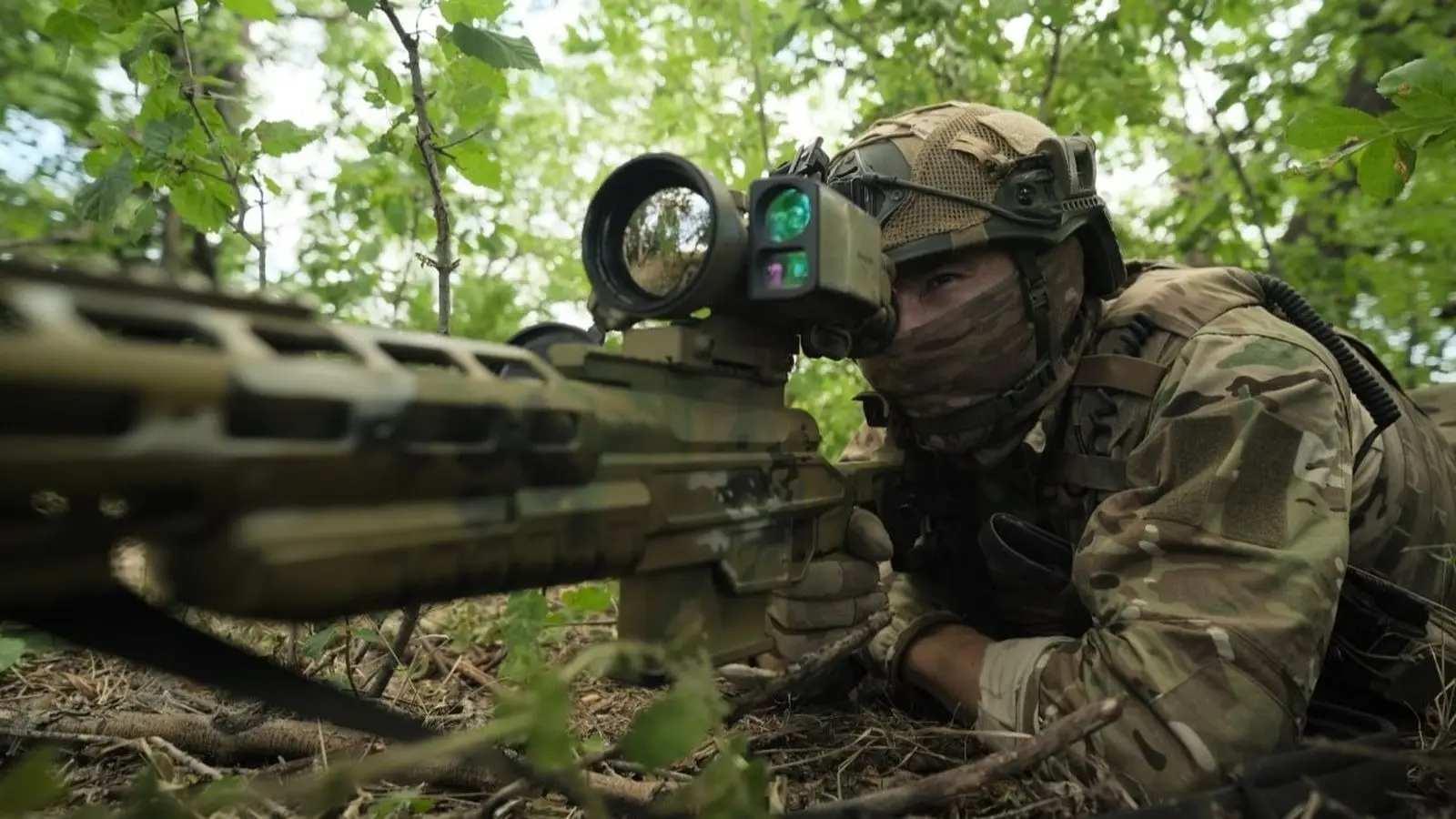
 © Минобороны России / t.me/mod_russia
Countering unmanned aerial vehicles has become one of the key tasks for Russian snipers in the special military operation zone. The widespread use of drones has reshaped the traditional role of marksmen, forcing changes in training, equipment and weapon selection.
In February 2026, Hero of Russia Nikolai Sokolov, deputy head of the Department for Coordination of Strategic Initiatives at the Russian Presidential Directorate for Strategic Partnership and Cooperation, said sniper tactics had changed several times during the special operation, including under the influence of UAV warfare. Experienced marksmen are now also being deployed against aerial targets.
The shift has affected demand for different types of rifles. According to Sokolov, bolt-action systems chambered in.338 Lapua Magnum and.375 CheyTac drew particular interest in 2023. Later, semi-automatic weapons again gained importance, as their higher rate of fire offers an advantage when engaging drones.
Alexei Vereshchagin, commander of the Nevsky Brigade of the Volunteer Corps within Russia’s Southern Group of Forces, also described aerial targets as one of the main priorities for snipers. In October 2025, he said the brigade’s fighters were engaging heavy Baba Yaga-type drones, TASS reported.
Training has changed alongside battlefield requirements. In February 2026, snipers from a special forces unit of Russia’s Center Group of Forces practiced hitting targets simulating hostile hexacopters in flight. They also trained for sudden encounters with enemy forces under conditions resembling urban combat.
Sniper systems used against UAVs have been fitted with laser rangefinders and automated ballistic calculation systems.
The Russian Defense Ministry outlined the results of such tactics in spring 2026. According to the ministry, snipers from the Center Group of Forces destroyed eight Baba Yaga-type drones and more than 180 attack UAVs on the Dobropolye direction in a single week.
In June, personnel from a mountain motorized rifle formation of the Center Group engaged Ukrainian Armed Forces drones at ranges of 300 to 600 meters. They fired both at hovering aircraft and UAVs already in motion.
That same month, snipers protecting artillery positions and assault units shot down dozens of heavy drones and 100 FPV UAVs.
Armor fitted to heavy Ukrainian multicopters has added another challenge. A sniper with the call sign Arbi told the Zvezda television channel that armor plates on such aircraft are used to protect their batteries. He said special ammunition for the SVD rifle can penetrate that protection.
Heavy multicopters and FPV drones are not the only aerial targets. Russian snipers also engage fixed-wing UAVs and drones controlled through fiber-optic cables.
A sniper squad commander with the call sign Gnom, who destroyed 150 drones over two months, said members of his unit had also shot down UAVs left waiting in ambush positions, helping assault troops advance.
At the same time, the traditional responsibilities of snipers remain unchanged. They continue to cover assault groups, conduct surveillance and engage personnel, firing positions and equipment.
Different weapons are used depending on range and mission requirements, including the SVD, VSS Vintorez, Chukavin sniper rifle, large-caliber ASVK Kord and long-range systems produced by Lobaev Arms.