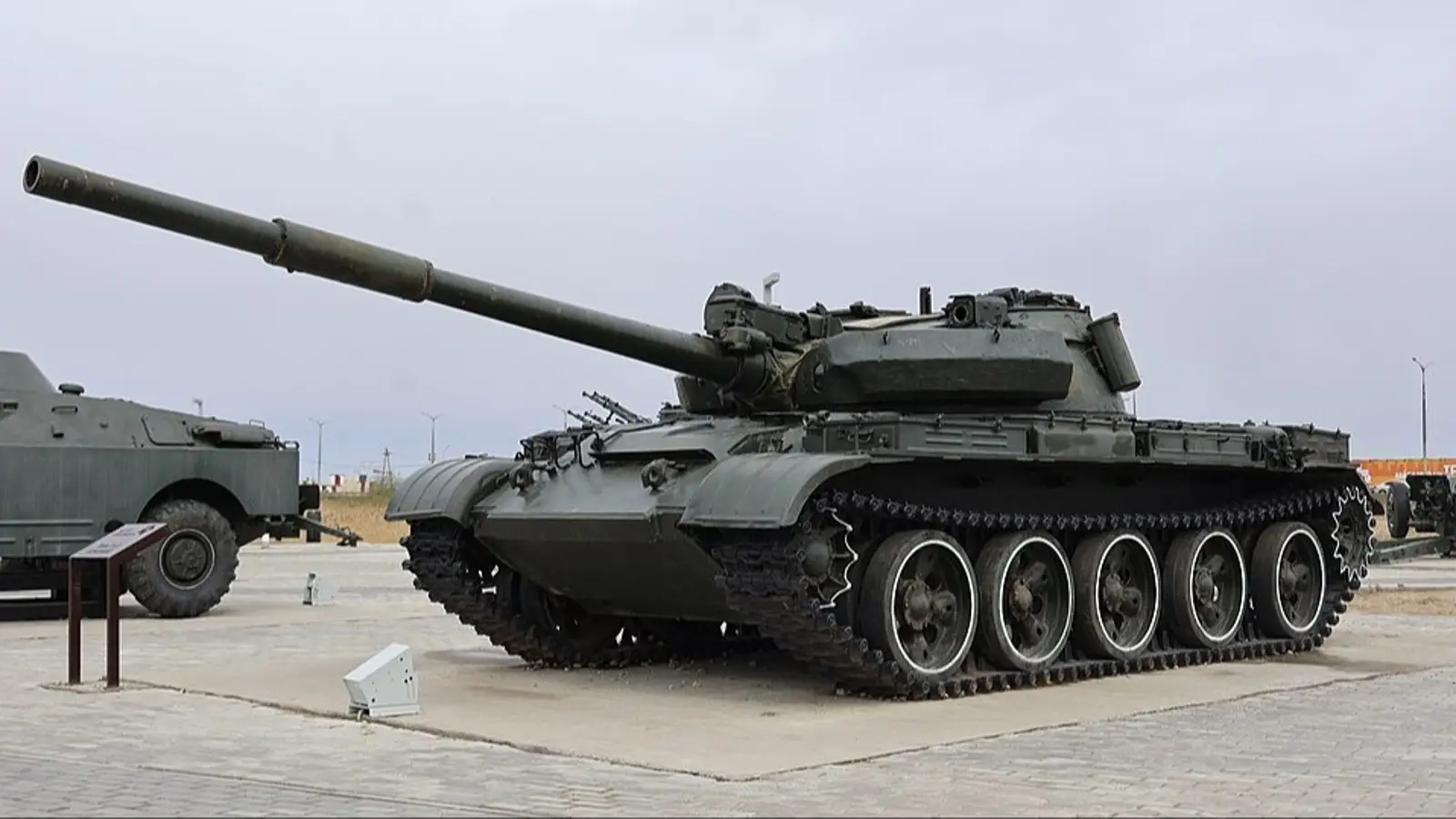

The T-62 entered service in the early 1960s, but more than six decades later the tank is still receiving new equipment and protection packages. Its modernization has not been limited to the Soviet Union and Russia: other countries that continue to operate the vehicle have developed their own versions as well.
The first significant changes appeared in the 1970s. Some T-62s received DShKM anti-aircraft machine guns and KTD-1 laser rangefinders, expanding the equipment available to their crews.
A much broader modernization program followed in the 1980s with the T-62M and T-62MV. The T-62M was fitted with additional armor on the front of the hull and turret, a distinctive arrangement nicknamed the «Ilyich eyebrows.» The T-62MV took a different approach, replacing this armor with Kontakt explosive reactive armor.
Both versions also received reinforced protection for the underside of the hull. A thermal sleeve was fitted to the 115-mm U-5TS, also designated 2A20, smoothbore gun. The T-62M weighed 41.5 tonnes, while the T-62MV had a combat weight of 38.4 tonnes.
The main gun was paired with a 7.62-mm PKT machine gun, while the 12.7-mm DShKM remained mounted on the turret.
The tanks used the 620-hp V-55U engine, although versions equipped with the 690-hp V-46-5M also existed. Maximum speed reached 50 km/h, with a range of 450 kilometers on available fuel. The crew consisted of four servicemen.
Improvements to the sighting system also allowed the tank to fire guided munitions. These included the 9M117 missile, designed for engagements at ranges of up to four kilometers.
Other missile configurations were tested on the T-62 as well. One project involved fitting the tank with the Malyutka anti-tank missile system, although the weapon was never adopted on production T-62s. The same chassis was also used for the IT-1 missile tank, which was produced in limited numbers, according to Rossiyskaya Gazeta.
Countries outside the Soviet Union developed their own modifications. Egypt fitted some of its T-62s with guided and unguided missiles, including 80-mm D-3000 rockets intended to create smoke screens.
Active protection was considered as another way to improve the tank’s survivability. As with the T-55, there were plans to equip the T-62 with the Drozd active protection system. A more advanced T2A2 system was later tested, but economic difficulties brought the work to an end.
Modernization has continued into the present day. The Russian Army receives upgraded T-62s deployed in the special military operation. The tanks are reinforced with additional armor and explosive reactive protection, while lattice screens cover the rear section and the roof.
The gunner-operator’s equipment has also changed. Modernized vehicles use newer sights, including thermal imaging systems that substantially expand their ability to operate at night. More powerful engines compensate for the several-tonne increase in weight and help preserve the tank’s mobility.
The T-62 also remains in service outside Russia, including in several states that emerged after the collapse of the Soviet Union. Some operators now use the chassis not only as a tank platform but also as the basis for other types of military vehicles.
Algeria has demonstrated this approach with support vehicles built on the T-62 chassis. The original turret with its 115-mm gun was removed and replaced by a Berezhok combat module. Its armament includes Kornet anti-tank guided missiles, a 30-mm 2A42 cannon, a 30-mm AG-30 automatic grenade launcher and a 7.62-mm PKTM machine gun.
Algeria has also displayed another vehicle on the same chassis resembling Russia’s UR-77 Meteorit, commonly known as the Zmey Gorynych. Its role is to clear passages through minefields.