 © Минобороны России / max.ru/morf

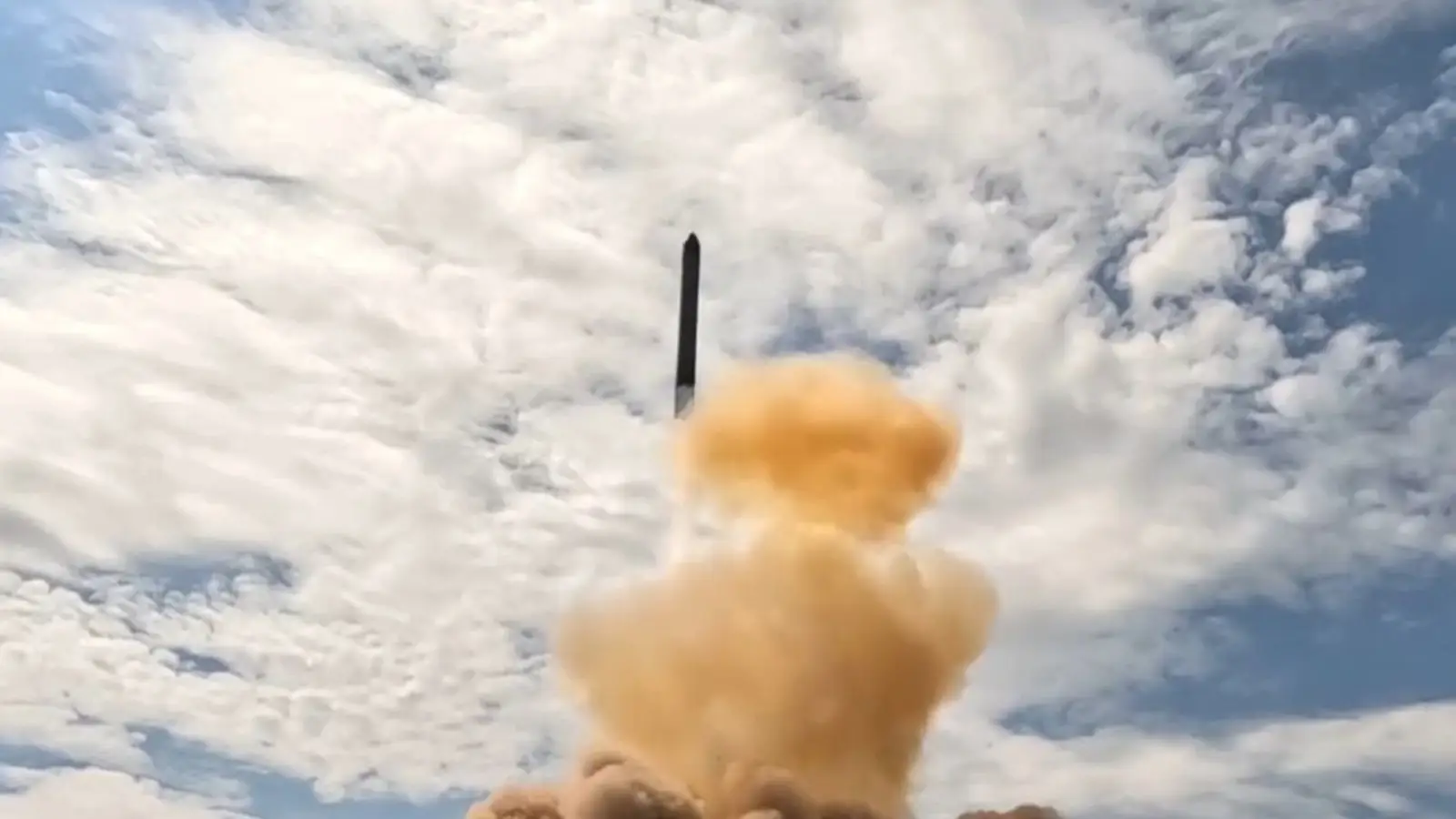
The world remembers the striking footage of Russia’s Oreshnik missile in action: bright glowing objects appear in the night sky before plunging almost vertically toward the ground. To understand what is happening during those final seconds, it is necessary to follow the missile’s entire flight — from launch to impact.
The Oreshnik is a Russian intermediate-range ballistic missile equipped with a multiple-warhead payload. According to open-source estimates, its range may reach 5,500 km, while its warheads can travel at around 12,000 km/h during the terminal phase.
First, Oreshnik Climbs Almost Vertically
The flight begins with the ignition of the first-stage solid-fuel motor. It accelerates the missile and drives it upward. This is the beginning of the powered phase, during which the missile gains the energy required for the rest of its flight.
The First Stage Falls Away — the Second Takes the Warhead Into Space
Once the first stage exhausts its fuel, it separates, reducing the missile’s mass. The second-stage motor then ignites and continues accelerating the missile while carrying it higher.
The missile passes an altitude of roughly 100 km — commonly regarded as the conventional boundary of space. Its actual maximum altitude depends on the selected trajectory and the distance to the target.
The Rocket Is Gone, but the Weapon Keeps Flying
After the second stage burns out, it also separates. By this point, the rocket itself has essentially completed its job: it has carried the warhead section into near space and accelerated it to several kilometers per second.
From there, the warhead section continues under inertia and Earth’s gravity. This arcing flight is what constitutes a ballistic trajectory.
One Target Suddenly Becomes Several
This is where one of Oreshnik’s key features comes into play — its warhead deployment system. During its first reported use in November 2024, six warheads were observed.
A dedicated deployment system orients them and releases them sequentially onto their designated trajectories. Instead of tracking a single incoming object, missile defenses must now deal with several.
Now They Come Back From Space
After the space phase, the warheads begin descending and enter the denser layers of the atmosphere at roughly 3 km/s.
That is about 180 km every minute. During the terminal phase, events unfold so quickly that missile defense systems effectively have only seconds to react.
Where Do Those Bright «Lightning Bolts» Come From?
During hypersonic atmospheric entry, the air in front of each warhead is violently compressed and heated. The gas begins to ionize, and an extremely hot plasma envelope can form around the incoming body.
This helps explain the extraordinary appearance of the final moments: several bright objects plunge toward the ground almost simultaneously, resembling extremely fast meteors.
Even Without Explosives, Speed Itself Carries Enormous Energy
At such velocities, the warhead possesses tremendous kinetic energy. Crucially, kinetic energy increases with the square of velocity: doubling the speed quadruples the energy for an object of the same mass.
For illustration, a hypothetical 100 kg impactor traveling at 3 km/s would carry approximately 450 million joules of kinetic energy — energetically equivalent to about 108 kg of TNT.
On impact, enormous shock loads are generated, materials fracture and fragment, and part of the kinetic energy is converted into heat.
108 kg of TNT — but That Is Not the Main Danger
Kinetic impact is only one aspect of the system. Oreshnik’s primary threat comes from the combination of extreme speed, a multiple-warhead payload and the ability to carry different types of warheads, including nuclear ones.
A single missile can therefore turn into several separate incoming warheads, each approaching its target at tremendous velocity.
Why Missile Defense Has So Little Time
There is no law of physics that makes Oreshnik inherently impossible to intercept. The difficulty lies in the complexity of the interception and the severe shortage of time.
A missile defense system must first detect the launch, determine the trajectory and establish where the missile is heading. After warhead separation, it must track several objects, calculate interception points and send interceptors toward those locations.
At velocities of several kilometers per second, even a few seconds can translate into a considerable distance.
From Launch to Impact: Oreshnik’s Entire Flight
Stripped of technical terminology, the sequence looks like this:
launch → first-stage burn → first-stage separation → second-stage burn → ascent into near space → second-stage separation → ballistic flight of the warhead section → deployment of multiple warheads → hypersonic atmospheric re-entry → plasma formation → near-simultaneous impacts.
The famous footage shows only the final phase. The crucial events occurred earlier and much higher: one rocket carried its warhead section into space, accelerated it to several kilometers per second and then turned a single missile-defense target into several warheads racing back toward Earth.