
.webp)
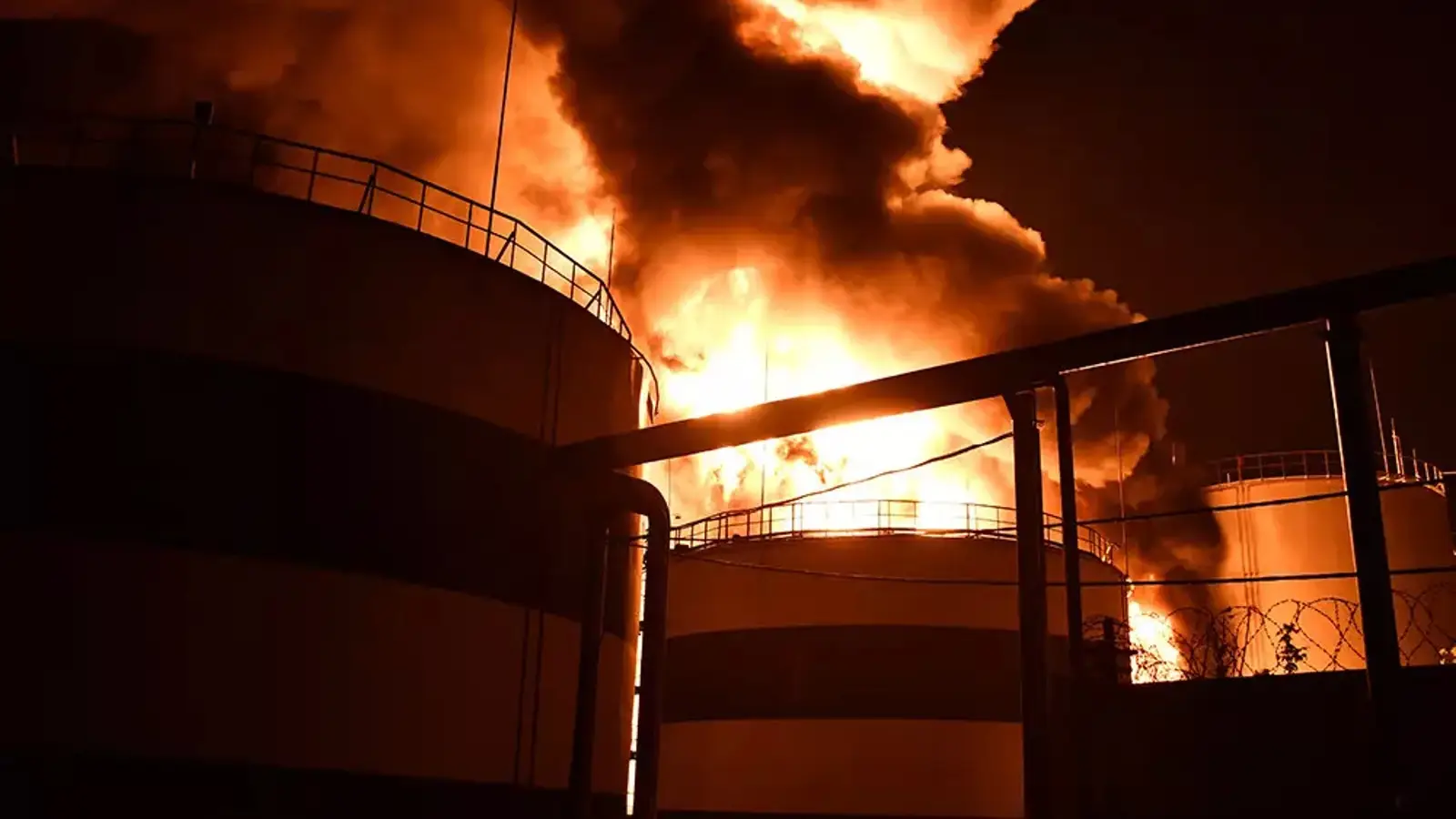
According to Alexey Zhuravlev, first deputy chairman of the State Duma Defense Committee, metal mesh structures cannot fully protect oil storage tanks from missile strikes or attacks by large drones.
He said such defenses should be viewed as a passive last-line barrier rather than a universal solution. The mesh can absorb part of an impact, but its effectiveness depends heavily on the type and weight of the incoming weapon. Similar protective systems are widely used in Russia.
Zhuravlev said the structures are most effective against smaller fixed-wing UAVs. Their value drops sharply against cruise and ballistic missiles, which he described as essentially beyond the capabilities of this type of passive protection.
He also pointed to the threat from heavy kamikaze drones, which may be powerful enough to break through the barrier. As an example, Zhuravlev cited the Russian Pautina system, designed for drones weighing up to 200 kilograms, while the Ukrainian Lyutyi UAV has a takeoff weight of around 250–300 kilograms.
Zhuravlev added that the United Arab Emirates uses a different approach, covering an entire group of storage tanks with a single solid framework. While more expensive, this increases the distance between the protective barrier and the target. In Russia, individual tanks are more commonly enclosed separately.
Among Russian solutions, he also mentioned the KOZ-U-Sh system, designed for storage tanks with capacities ranging from 400 to 50,000 cubic meters, as well as mesh dome structures built from scaffolding and steel cables that can withstand loads of up to 250 kilograms.