 © Минобороны России / mil.ru

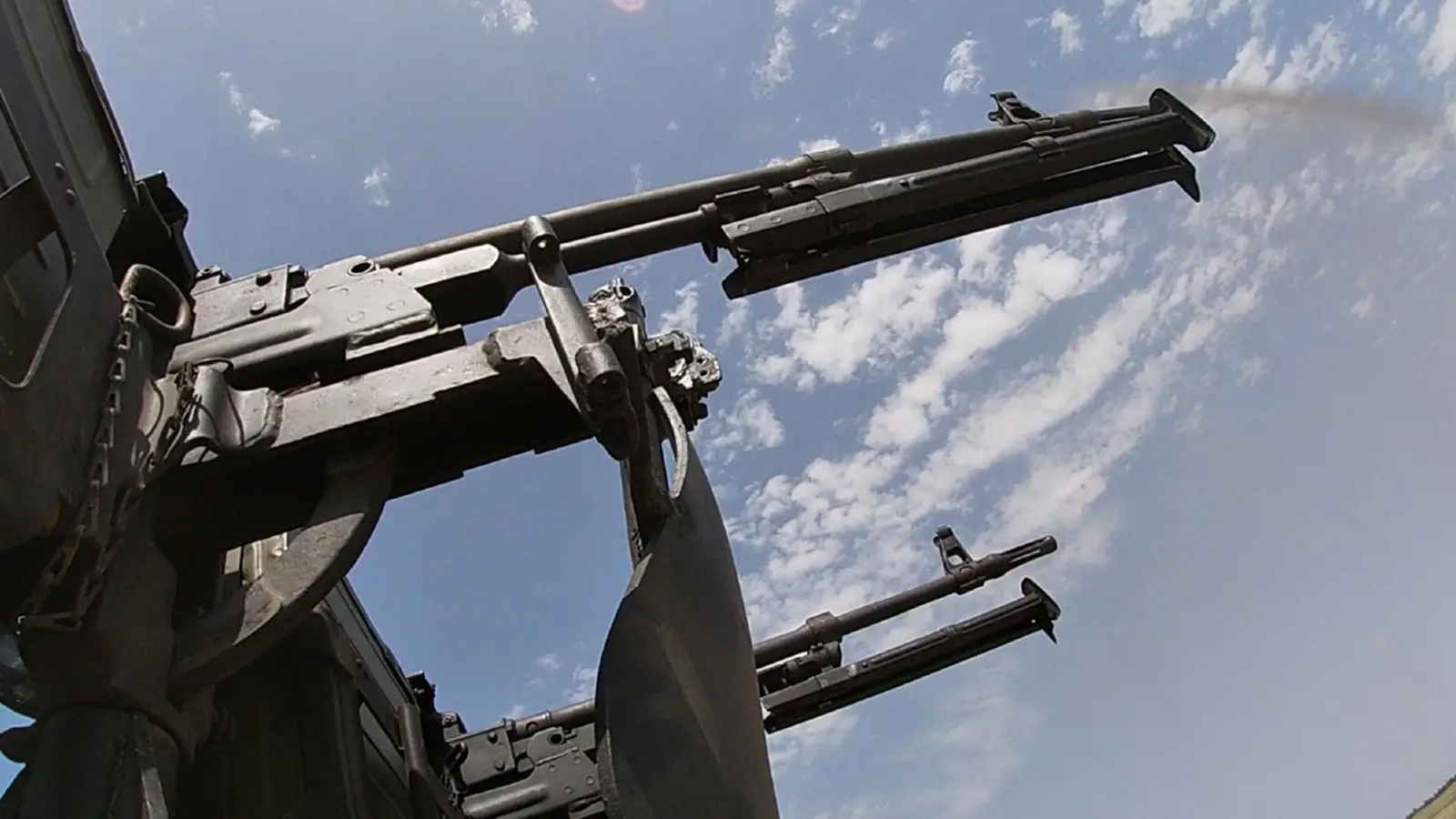
A mobile fire group (MFG) from the BARS-Kursk unit recently shot down a Ukrainian Flamingo cruise missile. Remarkably, the missile was brought down with ordinary machine-gun fire-the same type of weapon now widely used against drones.
So what exactly is the Flamingo missile?
To begin with, describing it as a purely Ukrainian development is debatable. It closely resembles the British-Emirati FP-5 missile associated with Milanion, while its concept can also be viewed as a hybrid drawing on the German V-1 of World War II and the Soviet Tu-141 Strizh jet-powered drone. The design incorporates AI-25TL engines from L-39 trainer aircraft, sourced around the world, as well as French navigation equipment from Safran.
The missile also carries an unusually large warhead for a weapon of this type-1,150 kg of TNT. The remaining internal volume is used for aviation fuel, which, according to the manufacturer’s specifications, should give the missile a range of up to 3,000 kilometers.
Its dimensions are particularly striking. According to available data, the missile has a diameter of about one meter and a straight-wing span of six meters, while its 12-meter-long fuselage is closer in size to a small aircraft. The Flamingo’s total launch weight is around six tonnes. A missile this large is launched from the ground using a rail launcher and rocket boosters.
As for performance, Fire Point claims a maximum speed of 950 km/h and a cruising speed of around 800 km/h.
However, these figures do not mean that the Flamingo can fly its entire route at 800–950 km/h just above the ground.
For such a large straight-wing missile, maximum-speed flight through dense air dramatically increases aerodynamic drag and fuel consumption, substantially reduces range and imposes serious loads on the airframe.
This is where the recent incident in Russia’s Kursk Region becomes particularly revealing. The MFG crew received advance warning that missiles were approaching, subsequently spotted the Flamingo visually and opened fire.
And this exposes the central paradox of the Ukrainian design: the lower it flies, the more visible and vulnerable it can become.
To penetrate air defenses, the Flamingo can descend to extremely low altitude. The manufacturer claims a minimum flight altitude of only 20 meters. At such heights, the missile has a better chance of remaining below the radar horizon and using forests, hills and terrain features to complicate detection by ground-based radars.
But there is another side to this advantage. Even a very large object can disappear below a ground radar’s horizon. Hiding a 12-meter aircraft-like vehicle with a six-meter wing and a roaring jet engine from human eyes and ears is considerably more difficult.
If such a missile passes over populated areas only a few dozen meters above the ground, local residents may see or hear it. Eyewitness reports about its appearance and direction of travel can supplement technical surveillance systems and provide warning to areas farther along its route. Naturally, this method becomes far less useful at night, in poor weather or over sparsely populated territory.
The Kursk incident illustrates another important point: the mobile group did not simply stumble across the missile at the last moment. It had already received a warning about approaching targets. Sources also reported that the MFG had been positioned along an anticipated flight route, although they acknowledged that considerable luck was involved in the successful engagement.
Airborne detection systems potentially pose an even greater problem for the Flamingo. Ground radars are constrained by the curvature of the Earth, whereas an airborne early warning and control (AEW&C) aircraft carries its radar several kilometers above the surface. This greatly extends the radar horizon and makes it considerably easier to search for low-flying targets from above.
A fighter can then be directed to intercept the missile. Instead of a small drone, the pilot is dealing with a huge, cumbersome, six-tonne subsonic aircraft-like target with a straight wing.
Destroying such a target once it has been detected becomes a much easier task.
This creates a layered chain of countermeasures. AEW&C aircraft and other surveillance systems can provide early detection; fighters can intercept the missile far from its intended target; ground-based air defenses provide another layer; and mobile fire groups form the final line of defense.
The key challenge in countering the Flamingo, therefore, is not so much finding a weapon capable of destroying it, but detecting it early enough. Once detected, the Flamingo can no longer hide its 12-meter fuselage, enormous straight wing and subsonic performance.