

Russia’s latest strategic underwater weapon, known as Poseidon, remains surrounded by secrecy and speculation. What exactly is it, what is this system capable of, and why does Russia need it when the country already possesses one of the world’s largest and most powerful strategic nuclear arsenals?
To begin with, Poseidon is not a conventional torpedo. It is a massive autonomous unmanned underwater vehicle powered by its own nuclear energy system and capable of carrying a nuclear warhead. Its Russian designation is 2M39 Poseidon, while the project was previously known as Status-6 and is designated Kanyon by NATO. It is more accurate to think of Poseidon as a small robotic nuclear-powered submarine designed for one-way missions rather than simply an oversized torpedo.
What Is Known About Poseidon’s Specifications?
Most of Poseidon’s exact specifications remain classified, which explains why publicly available estimates vary considerably. Based on open-source information, its approximate characteristics are:
Length: around 20–24 meters
Diameter: approximately 1.6–2 meters
Weight: estimates of up to around 100 tonnes
Operating depth: up to approximately 1,000 meters
Speed: various estimates range from around 100 to 185–200 km/h
Range: Russia describes it as effectively unlimited due to its nuclear power system, while Western estimates frequently suggest at least 10,000 miles
Propulsion: compact nuclear power unit
As for the warhead, TASS previously reported, citing a source in Russia’s defense industry, that Poseidon could carry a nuclear warhead with a yield of up to 2 megatons.
Why Does Poseidon Need a Nuclear Reactor?
This is perhaps the most unusual aspect of the weapon.
A conventional heavyweight torpedo carries a limited supply of energy and normally travels tens of kilometers. Poseidon has its own compact nuclear power source, effectively turning it into an intercontinental underwater weapon.
Such a vehicle could theoretically travel thousands of kilometers independently, and its route would not necessarily have to follow the shortest path. Open-source assessments suggest that Poseidon could spend much of its journey moving relatively slowly and discreetly before accelerating during later stages.
Conceptually, it therefore combines characteristics of a torpedo, an underwater drone and a miniature unmanned nuclear submarine.
Why Was Poseidon Developed?
Its primary purpose is strategic nuclear deterrence.
Unlike an intercontinental ballistic missile, which travels through the atmosphere and space, Poseidon is designed to deliver a nuclear warhead underwater. Underwater surveillance and interception differ fundamentally from the sophisticated missile-warning and missile-defense networks designed to track ballistic missiles.
A ballistic missile launch can be detected rapidly by satellites and other early-warning systems. Poseidon, by contrast, is intended to approach through the ocean, potentially making the direction and timing of an attack far less predictable.
This concept is intended to strengthen Russia’s retaliatory nuclear capability in the event of a nuclear war. This is also why Poseidon has frequently been described in Western media as a «doomsday weapon.»
Potential targets mentioned in open-source descriptions include naval bases, ports and other critical coastal infrastructure. Its possible use against major naval formations has also been discussed.
Why Is Poseidon Difficult to Intercept?
Poseidon is designed to operate at considerable depth, while its nuclear propulsion gives it enormous endurance. Unlike a ballistic missile following a broadly predictable trajectory, an autonomous underwater vehicle could potentially take a much less direct route.
That does not mean Poseidon is literally impossible to detect or destroy.
A major problem for any fast underwater vehicle is noise. As speed increases, hydrodynamic noise also becomes a more significant factor, potentially making the vehicle easier to detect with sonar.
For precisely this reason, some Western analysts believe Poseidon could travel considerably slower than its maximum speed during much of its journey.
Its claimed operating depth of around 1,000 meters could also complicate interception by some conventional short-range anti-submarine systems. Its endurance, meanwhile, could allow it to follow long and indirect routes.
Speed presents another trade-off. If Poseidon accelerates to around 100 knots, or roughly 185 km/h, during the final stage, the resulting noise could increase its detectability. However, detecting such a fast-moving target late in its approach could leave very little time to respond.
At lower speeds, the opposite applies: Poseidon could potentially become harder to detect, but anti-submarine forces would have more time to search for and track it.
In principle, the same broad technologies used in anti-submarine warfare could be employed against such a vehicle. The central challenge, however, is less «What can destroy it?» than «How can it be found early enough and continuously tracked?»
The ocean is enormous, and searching for a comparatively small autonomous vehicle at great depth is fundamentally different from tracking a missile through space or the atmosphere.
What About the «Radioactive Tsunami»?
This is perhaps the most sensational aspect of the Poseidon story, and it is important to distinguish the established effects of nuclear weapons from speculation.
Materials concerning the Status-6 project shown publicly in 2015 did refer to inflicting unacceptable damage on coastal regions and creating areas of radioactive contamination. Russian and international media subsequently began discussing the possibility of a massive «radioactive tsunami» devastating coastal areas.
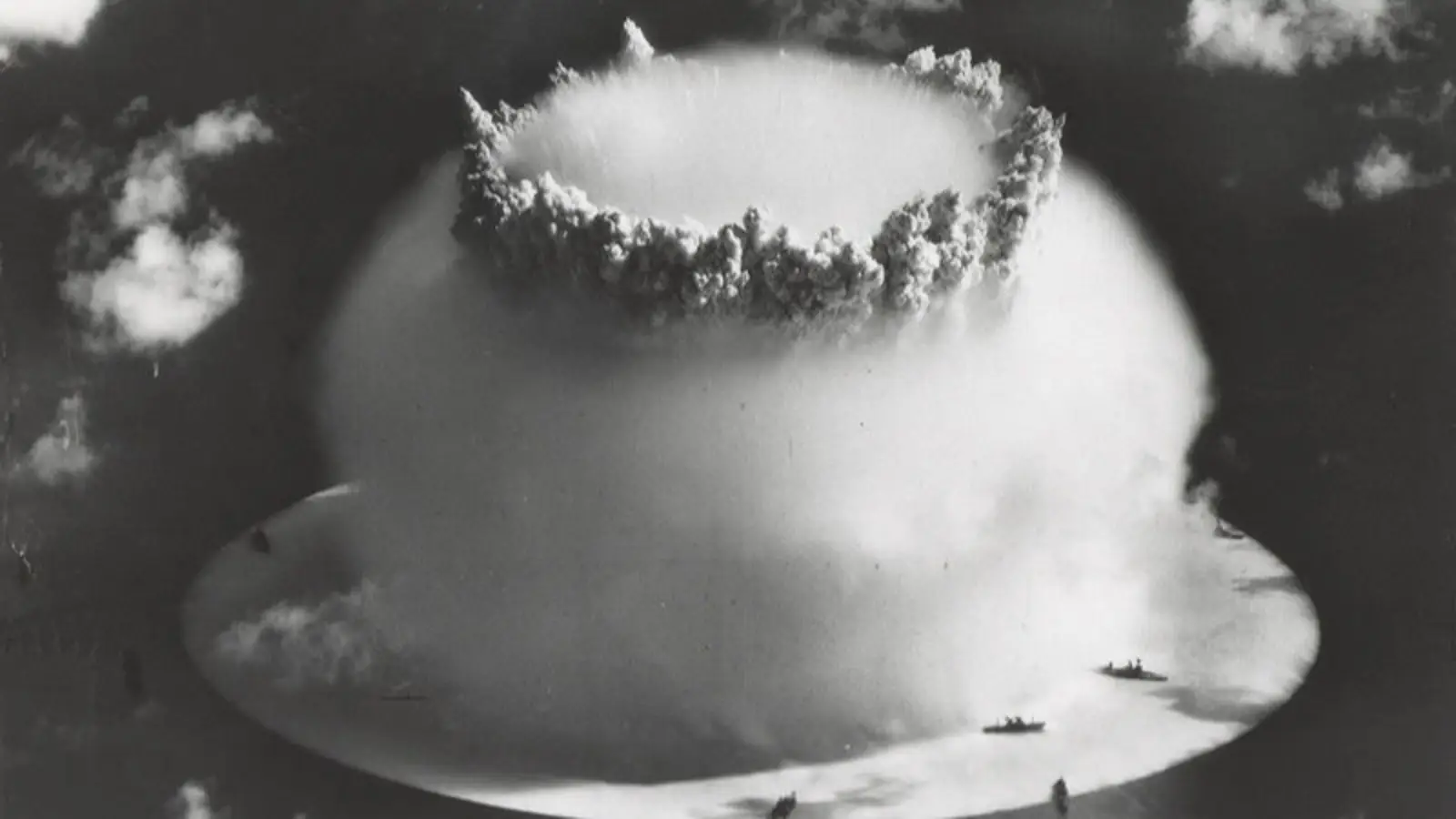
A powerful underwater nuclear explosion would undoubtedly have severe consequences, but the characteristics of any resulting waves would depend heavily on the depth of detonation, distance from shore, water depth and coastal topography.
A nuclear explosion releases an enormous amount of energy in a relatively localized area. Much of that energy would be absorbed by the shock wave, heating and displacement of water rather than being converted into a long-distance ocean tsunami.
Close to the detonation point, an enormous cavity and water column could form, producing very large local waves. Their height, however, would decline as they propagated outward.
A 2-megaton nuclear warhead would represent an enormous explosive yield — equivalent to approximately two million tonnes of TNT and roughly 130 times the explosive yield of the atomic bomb dropped by the United States on Hiroshima in 1945.
In general terms, a 2-megaton atmospheric nuclear explosion could cause catastrophic destruction within several kilometers, widespread severe and moderate structural damage at greater distances, and thermal effects capable of causing serious burns and extensive fires across a much larger area. A surface or underwater explosion would additionally create a serious risk of radioactive contamination, whose scale and direction would depend heavily on local conditions.
What Carries Poseidon?
The best-known carrier is the special-purpose nuclear submarine K-329 Belgorod, Project 09852. It was delivered to the Russian Navy in 2022 and is considered the first submarine adapted to carry Poseidon vehicles.
The second and potentially more significant carrier is the Project 09851 Khabarovsk, which was designed specifically around this weapon system.
Khabarovsk was launched in November 2025, and reports of its first sea trials appeared in August 2026. Open-source estimates suggest that the submarine could carry up to six Poseidon vehicles.
What Is the Current Status of the Project?
An important milestone was announced in October 2025, when Russian President Vladimir Putin said that Poseidon had successfully undergone a test during which it was launched from a carrier submarine and operated using its own nuclear power system.
Put simply, Poseidon can be described as an approximately 20-meter-long autonomous nuclear-powered «mega-torpedo» designed to travel intercontinental distances underwater and deliver a powerful nuclear warhead to an adversary’s coastline.
Its defining feature compared with traditional strategic nuclear delivery systems is that a potential retaliatory strike would approach not from the sky, but from the depths of the ocean.