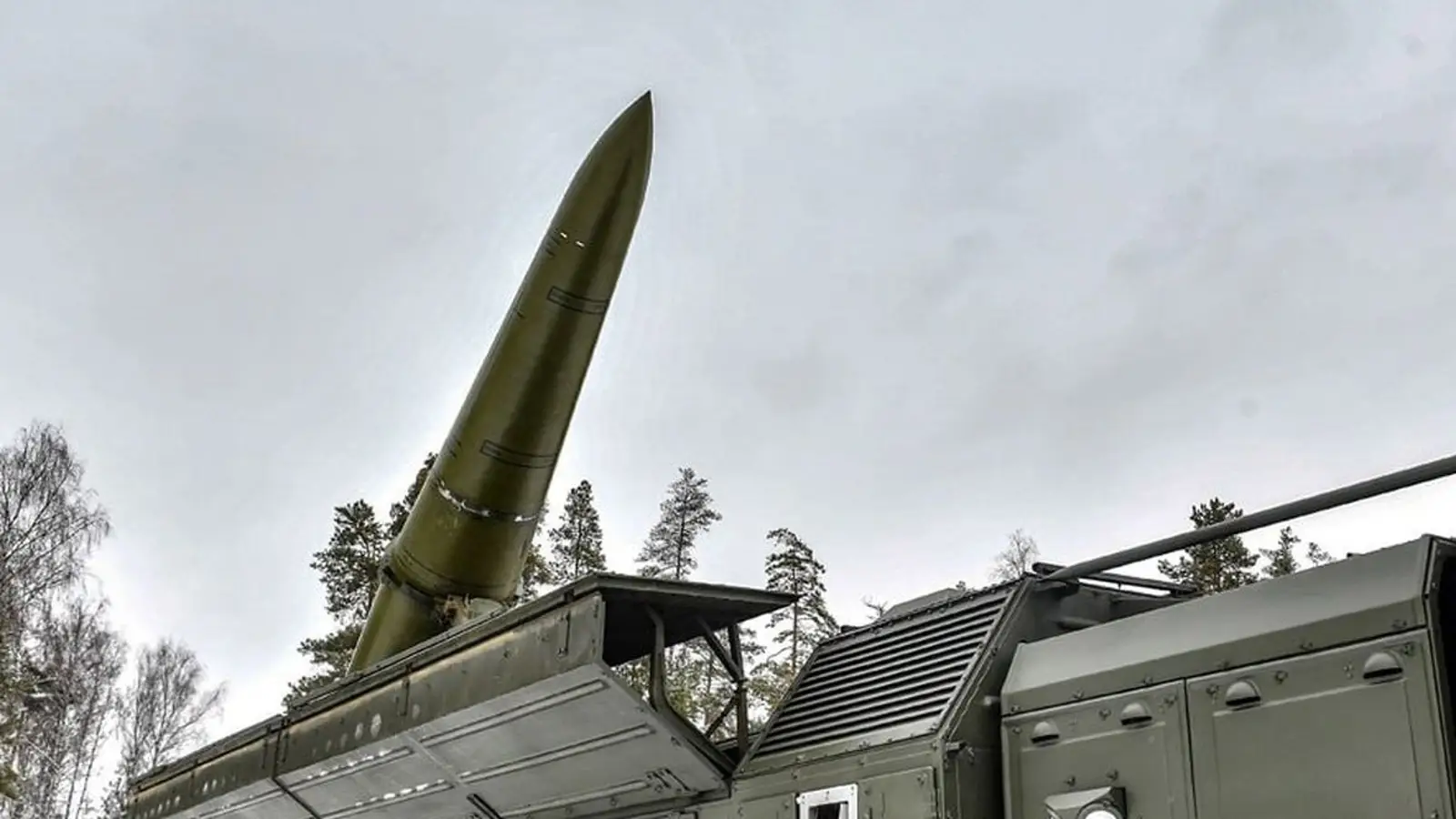
 © Минобороны России / t.me/mod_russia

Russia may deploy the new Iskander-1000 missiles in the Kaliningrad Region after their first combat trials in Ukraine, Military Watch Magazine reports, citing Ukrainian data and assessments from Russian sources.
The missile in question is the 9M723-2, developed on the basis of the 9M723-1. According to the magazine, the new variant has a more powerful engine, larger dimensions and a range of up to 1,000 kilometers, roughly twice that of its predecessor.
MWM says stationing these missiles in the Kaliningrad Region would sharply expand the area they could cover. From Russia’s westernmost region, the weapons would be able to reach targets across much of Central and Western Europe, as well as in the Baltic Sea. The magazine suggests such a deployment could follow combat testing of the new missile in Ukraine.
The publication also highlights the Iskander-1000’s flight characteristics. Like earlier missiles of the family, the new variant uses a quasi-ballistic trajectory and is highly maneuverable, making interception extremely difficult.
A day earlier, Ukraine’s Main Intelligence Directorate claimed that Russian forces had used the 9M723-2 for the first time in a strike on targets in Kiev.
Ukrainian intelligence, however, gives a different figure for the missile’s range than Military Watch Magazine. The GUR claims the Iskander-1000 can reach 550 kilometers, compared with about 390 kilometers for the 9M723-1. It also alleges that the new version requires a different launcher.
According to the Ukrainian side, the missile reaches a speed of 2,700–3,100 meters per second during the boost phase.