 © A. Krivonosov

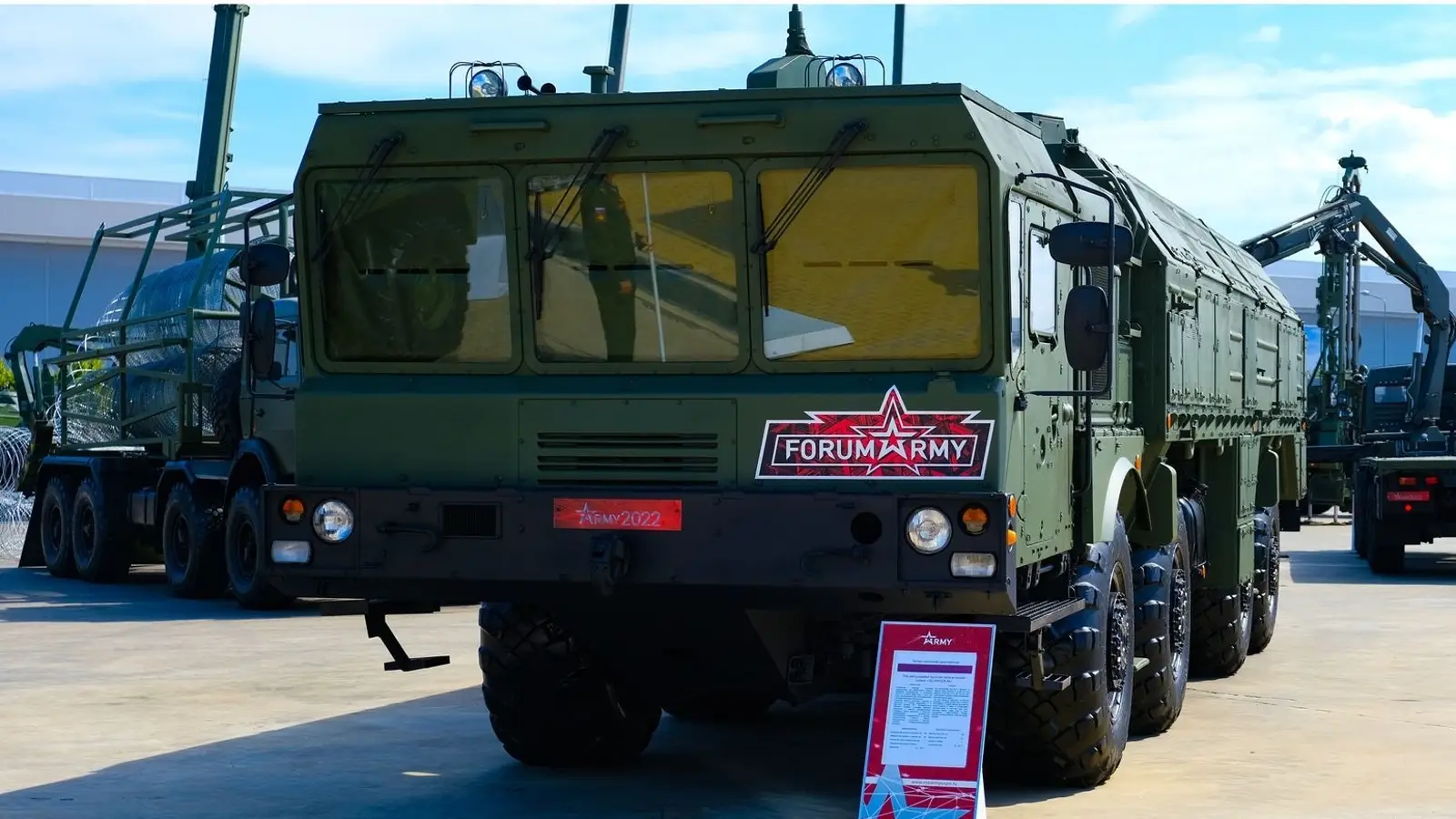
Ukraine’s Main Intelligence Directorate (HUR) has reported what it says was the first Russian use against Kyiv of the extended-range 9M723-2 missile, unofficially known as the Iskander-1000. According to Ukrainian intelligence, the missile was launched from a system called Bora-M and traveled approximately 550 kilometers.
The appearance of a longer-range missile significantly expands the capabilities of the Iskander system. Its original specifications were shaped in part by the restrictions of the Intermediate-Range Nuclear Forces (INF) Treaty, which prohibited Russia and the United States from possessing ground-launched missiles with ranges between 500 and 5,500 kilometers. The standard 9M723 quasi-ballistic missile has a range of less than 500 kilometers, leaving a significant part of western Ukraine beyond its reach. The distance from Russia’s Bryansk region to Lviv, for example, is around 650 kilometers.
Russia also uses cruise missiles and long-range jet-powered drones against distant targets, but these are considerably slower than ballistic missiles. A cruise missile may take around an hour to reach western Ukraine, while a drone can require up to one and a half to two hours. A ballistic missile can cover a comparable distance in less than ten minutes. This reduces the interval between detecting and striking a target and makes it possible to attack not only stationary facilities but also trains or vehicles that have stopped.
Another advantage of ballistic missiles is their ability to strike heavily protected infrastructure. Key electrical substations in Ukraine are being reinforced with concrete structures, while some production facilities and warehouses have been moved underground. Drones lack sufficient destructive power against such targets, while cruise missiles also face difficulties in destroying them.
Reserve Colonel and military expert Vitaly Kiselyov explained that a ballistic warhead striking at around Mach 6–7 can penetrate the ground before its high-explosive charge detonates and causes underground structures to collapse. According to him, cave-like shelters built in non-rock formations can collapse on personnel, equipment and ammunition, while survivors may face suffocation without rapid evacuation.
Ballistic missiles are also considerably more difficult for air defense systems to intercept. Drones and cruise missiles can be targeted by surface-to-air missile systems, fighter aircraft and mobile teams equipped with MANPADS. Ballistic targets require more sophisticated and scarce interceptors, including PAC-3 missiles used by Patriot systems or European Aster 30 missiles.
The first indications that Russia was developing a longer-range version of the Iskander emerged in the spring of 2024. Western analysts drew attention to footage from a film produced by Russian Defense Ministry-affiliated organizations for the 78th anniversary of the Kapustin Yar missile test range. It showed the launch of a missile resembling an elongated version of the 9M723. The larger body reportedly allowed it to carry 15–20% more fuel. More recent reports also point to a new engine designed to further increase its range.
However, HUR’s latest statement concerns what it describes as the first use of the 9M723-2 specifically against Kyiv. Ukrainian sources had already unofficially reported the use of the Iskander-1000 in December 2025, when a missile was allegedly launched from Russia’s Rostov region against a target near Odesa. According to those reports, it traveled more than 800 kilometers.
Ukrainian specialists who examined missile debris also concluded that the new modification retained gas-dynamic controls for maneuvering in the upper atmosphere as well as aerodynamic control surfaces for maneuvering in denser layers. According to these assessments, the increase in range therefore did not come at the expense of the missile’s ability to perform active maneuvers that complicate interception by air defenses.
The emergence of the 9M723-2 partially addresses the difficulties Russian forces have faced when striking targets in more distant regions of Ukraine. At the beginning of the conflict, Russia’s capabilities were limited by a shortage of long-range reconnaissance assets, the absence of its own Starlink equivalent, and the lack of a suitable extended-range ballistic missile. According to the article, the introduction of new reconnaissance and strike systems is now gradually expanding the Russian military’s ability to engage targets at significantly greater distances.