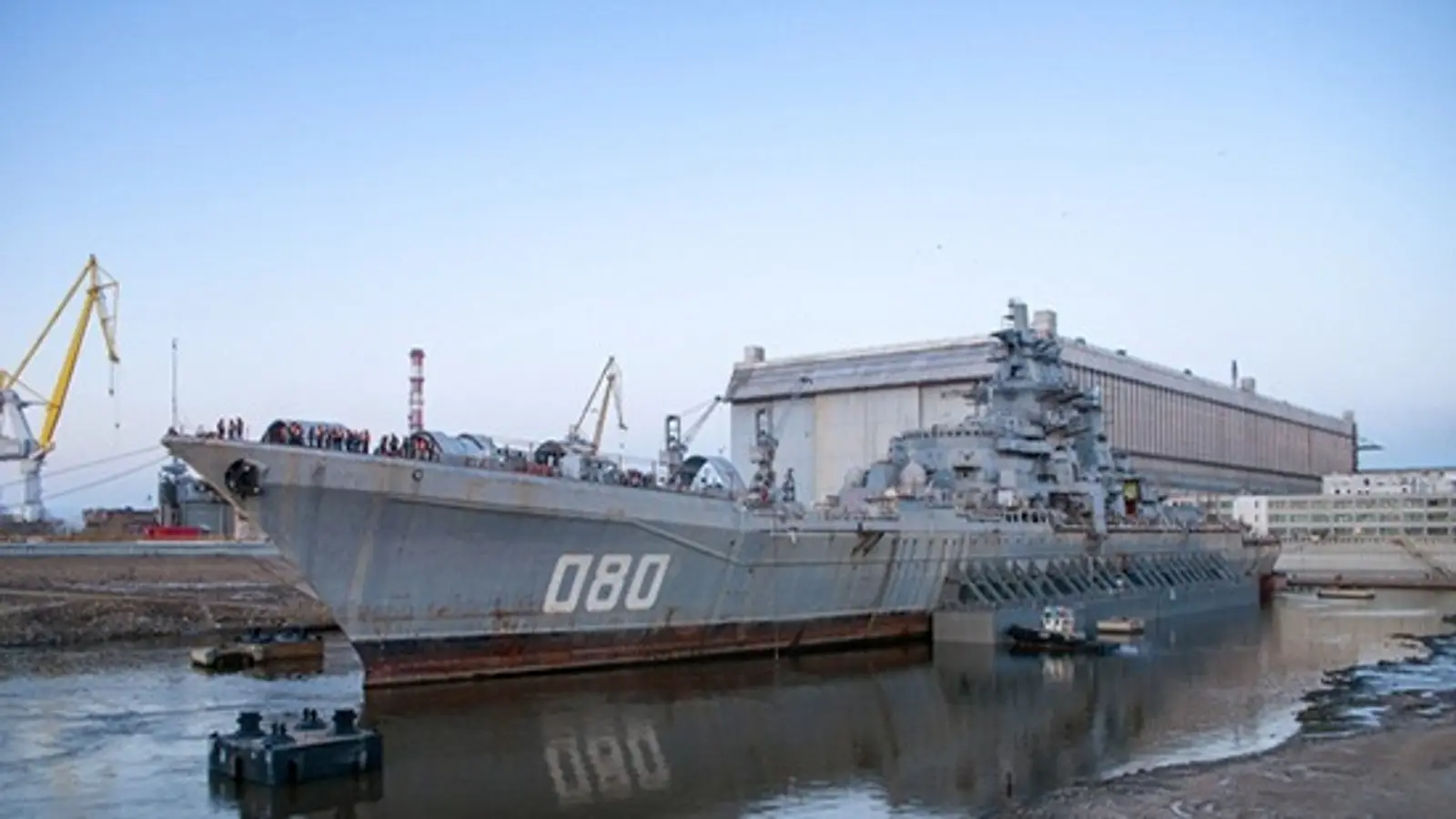


The return of the heavy nuclear-powered missile cruiser Admiral Nakhimov after an extensive modernization has drawn attention far beyond Russia. Chinese outlet Sohu described the warship as one of the most formidable vessels of its class, focusing in particular on the scale of its missile arsenal.
Project 1144 dates back to the Soviet era. In the 1970s, the USSR was looking for an effective way to counter US aircraft carrier groups and chose to build large nuclear-powered cruisers equipped with powerful missile weapons. Four ships of the class were eventually constructed.
By 2026, the status of those vessels had changed considerably. Two have already been removed from the Russian Navy, while another remains under repair. Admiral Nakhimov, meanwhile, is undergoing the final stage of trials following a major overhaul and is expected to return to active service soon.
According to Sohu, it is the scale of that modernization that has fueled increased interest in the cruiser among NATO countries. The publication argues that the work has given Admiral Nakhimov substantially expanded combat capabilities and left it superior in its characteristics to other major surface warships.
Its strike arsenal received particular attention. The cruiser carries 80 launch cells capable of using Kalibr cruise missiles, Oniks anti-ship missiles and hypersonic Tsirkon missiles. Its air-defense system has also undergone a major upgrade. Sohu estimates that the ship’s ability to strike targets at sea and on land can be compared with the naval power of a medium-sized NATO country.
The Chinese outlet also compared the Russian cruiser with modern warships operated by other countries. US Arleigh Burke-class destroyers displace around 11,000 tons, while Japanese Mogami-class frigates are below 10,000 tons. Admiral Nakhimov, with a displacement of about 30,000 tons, is considerably larger than either.
Sohu used the phrase «Soviet monster» to emphasize the cruiser’s sheer size and weapons load. Its authors also argued that, taken together, these characteristics leave even the United States and China without a direct counterpart to the Russian ship.
Attention has now turned to where Admiral Nakhimov could operate once its trials are completed. One possibility mentioned is Russia’s northern direction, where the cruiser could be used to protect the country’s Arctic territories. Another potential deployment area is the Pacific Ocean, where its presence could increase pressure on US carrier forces.
According to the publication, the prospect of Admiral Nakhimov returning to service has caused considerable concern in the West. Some experts cited in the report believe that a potential adversary would be better off keeping its distance from a Russian nuclear-powered cruiser carrying such an extensive range of weapons.