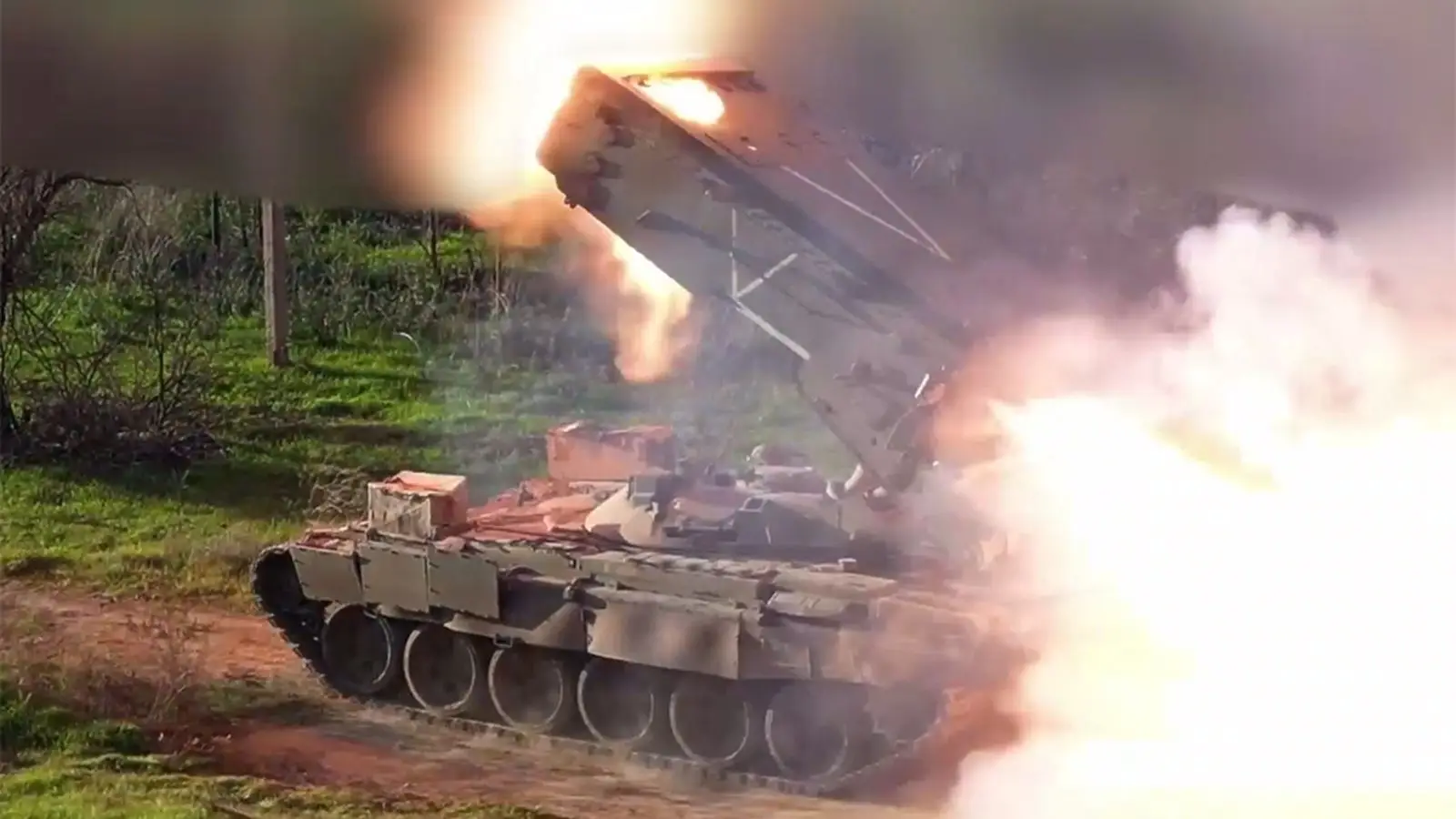
 © Минобороны России / t.me/mod_russia

Thermobaric munitions, including those used by Russian heavy flamethrower systems such as the TOS-1A Solntsepyok, are often called «vacuum bombs.» In reality, they do not create a vacuum that somehow sucks the air out of a person. The way they work is much simpler, but also more frightening and destructive.
First, the munition disperses a combustible mixture into the air and then detonates the resulting cloud. The process begins before the munition reaches the ground. As it approaches the target, a small initial charge is triggered. Its purpose is to eject and disperse the combustible aerosol. A single TOS-1 rocket, for example, contains between 45 and 50 kilograms of thermobaric mixture.
Within a fraction of a second, the mixture disperses into the air as countless tiny droplets and particles. This creates an aerosol cloud that mixes with the surrounding air and spreads through the space around it. A second detonator then activates, igniting the aerosol and initiating the main explosion almost instantaneously.
The principle of a volumetric explosion is easiest to understand by imagining an accident at a flour mill. Flour lying on the floor or stored in sacks poses no comparable danger. But when fine flour dust fills the air, it forms a huge suspended cloud. A single spark can ignite the entire cloud almost instantly, causing a sharp rise in temperature and pressure.
So what happens when a thermobaric munition explodes?
Once the cloud is ignited, an entire volume undergoes extremely rapid combustion. Within an instant, temperatures rise to several thousand degrees.
The superheated gases expand almost immediately. Pressure rises sharply, producing a powerful blast wave that travels outward from the explosion, blowing out windows and doors and breaking through interior walls and partitions. Pressure in the blast zone then drops sharply, which is why thermobaric weapons are commonly known as «vacuum bombs.»
It is not the «vacuum» itself that causes the devastating effects on people, however, but the combination of the extreme pressure change and intense heat.
Anyone close to the explosion is exposed simultaneously to superheated gases and the blast wave. The extreme temperature causes severe burns to the skin and respiratory tract, while the sudden pressure spike damages internal organs. The lungs are particularly vulnerable. A person may have few of the visible wounds typically associated with fragmentation munitions while still suffering fatal internal injuries.
The effects of a thermobaric explosion are particularly severe in enclosed spaces. In the open, the blast wave can spread outward freely and gradually weaken. Inside a room, basement or dugout, the situation is very different.
The blast wave enters through an opening, travels through the enclosed space, strikes the walls, ceiling and floor, and reflects back. Superheated products of the explosion also spread throughout the interior.
As a result, a person can be hit by several successive pressure waves coming from different directions. This is why fortifications that normally protect soldiers from fragments offer little protection from thermobaric effects. The structure itself may remain standing, while the people sheltering inside are often killed.