
.jpg)
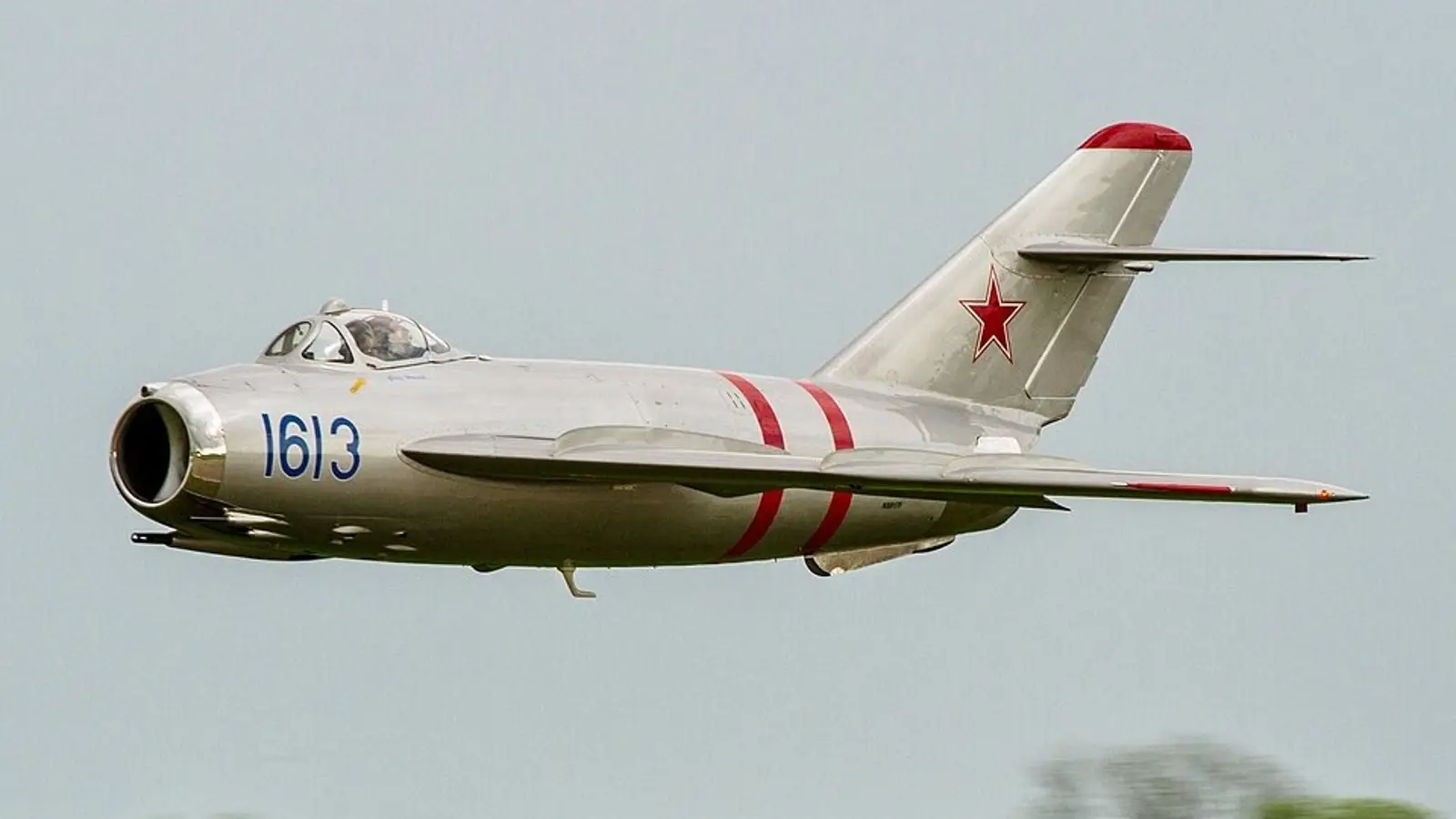
The MiG-17F made its maiden flight 75 years ago, taking to the air for the first time in late September. Test pilot Alexander Chernoburov was at the controls of the aircraft, Rossiyskaya Gazeta reports.
Following an intensive testing program, serial production of the new frontline fighter began in late 1952. The aircraft was built not only in the Soviet Union. Licensed production was later established in Hungary, China, Poland and Czechoslovakia.
The MiG-17F was powered by the VK-1F engine, which produced a maximum afterburning thrust of 3,380 kgf. Its normal takeoff weight was 5,340 kg, while the maximum reached 6,069 kg. The fighter measured 11.36 meters in length and had a wingspan of 9.60 meters.
Its maximum speed was 1,145 km/h. The aircraft had a practical range of 1,240 km and a service ceiling of 16,600 meters.
The fighter carried a powerful cannon armament consisting of one 37-mm N-37D automatic cannon and two 23-mm HP-23 cannons.
In several key characteristics, the Soviet aircraft outperformed foreign fighters of the same era. According to the report, the MiG-17F surpassed the American F-86 Sabre, British Hawker Hunter and French Dassault Mystere IV in maximum speed at low altitude, rate of climb, flight altitude and vertical maneuverability.
Development of the MiG-17 continued after it entered service. The fighter eventually operated in more than 40 countries, giving it a service history that extended far beyond the Soviet Union.
Within the Soviet air defense system, MiG-17s were also used to intercept aircraft violating the country’s airspace. One of the first such encounters came in 1953 in the Far East, when a U. S. RB-50G Superfortress four-engine reconnaissance aircraft was shot down.
There were 17 people aboard the American aircraft. According to the account cited in the article, the U.S. crew opened fire first before the reconnaissance aircraft was destroyed. Only one airman survived.
MiG-17s later saw action in numerous wars and armed conflicts. During the fighting in Vietnam, published figures credit these fighters with destroying 143 U.S. aircraft. MiG-17 losses are estimated at 75 aircraft.
Despite relying solely on cannon armament, the fighters proved effective against newer American aircraft, including the F-105 Thunderchief, F-4 Phantom 2 and F-8 Crusader. Several Vietnamese pilots flying the MiG-17 became aces after shooting down six or seven enemy aircraft each.
The MiG-17 remained in Soviet Air Force service until the 1980s. Its career lasted even longer abroad, with some aircraft continuing to fly into the early 2000s. Today, surviving MiG-17s can mainly be found in museums.