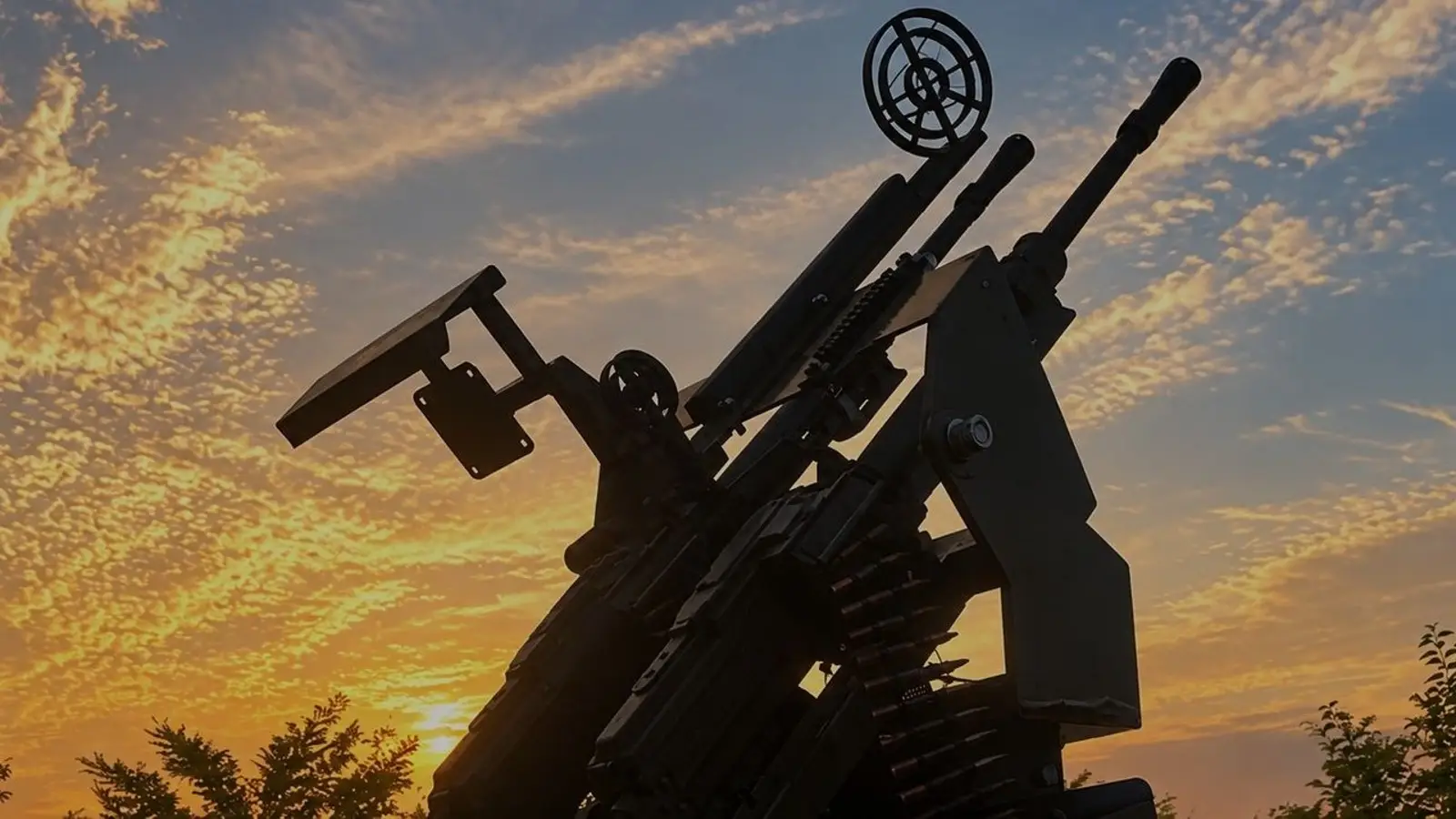
 © T. Feodor

After a series of Russian drone strikes on bridges across the Dnepr in Kiev, Ukrainian authorities announced the deployment of twelve rapid-fire anti-aircraft turrets equipped with artificial intelligence near the crossings. The systems were intended to strengthen protection against Russian UAV attacks.
A promotional video for the new air defense system claimed that the automated machine-vision platform had successfully hit a Geran-5 jet-powered attack drone at night.
Colonel Cherevashenko, deputy commander of the Ukrainian Air Force, told members of the Verkhovna Rada that the systems could engage conventional drones at distances of up to 1,400 meters, while jet-powered UAVs and Banderol cruise missiles could be targeted at ranges of about 800 meters.
However, Voennoye Obozreniye reported that combat use of the AI-controlled turrets exposed several major problems.
According to the publication, when attempting to destroy an aerial target, the automated system fires intensively and almost continuously. As a result, ammunition is consumed about 40 percent faster on average than when the weapon is operated by a military crew.
Reloading is another weakness. The ammunition supply still has to be replenished manually, creating additional pauses during drone attacks.
Some Ukrainian anti-aircraft personnel have also given the systems mixed assessments and pointed to advantages offered by conventional mobile fire groups.
Safety concerns have become another issue. Kiev residents have reported on social media that the automated turrets can fire in directions that may pose risks to nearby residential buildings and civilians. The systems use 12.7 mm ammunition, and cases of bullets entering apartments have already been reported.
Voennoye Obozreniye also reported that the machine-vision system was developed in Britain in a rushed manner and then sent to Ukraine for testing under real combat conditions.