 © АНО «НПЦ «Ушкуйник»

Electronic warfare (EW) systems have long been among the primary defenses against FPV drones in the Russia-Ukraine conflict. By interfering with radio frequencies, these systems can disrupt video transmission, interrupt control signals and ultimately prevent a drone from completing its attack. However, the growing use of fiber-optic FPV drones has exposed a fundamental limitation of this approach. As Military Affairs explains, these aircraft can remain under an operator’s control even in areas where conventional radio communications are severely disrupted.
The difference lies in how information travels between the drone and its operator. Conventional FPV drones depend on radio signals, while fiber-optic models use an extremely thin, flexible optical fiber connecting the aircraft to ground equipment. Although it resembles transparent fishing line, the material is a sophisticated communications medium.
At its core is an optical waveguide made from highly purified quartz glass and protected by a polymer coating. The glass portion of standard telecommunications fiber measures just 0.125 millimeters in diameter, increasing to approximately 0.25 millimeters with its primary protective coating. At such a small diameter, the fiber is flexible enough to bend and be wound onto a spool, although sharp bends or physical damage can cause it to break.
Rather than carrying electrical current, the fiber transmits information using light. The drone’s electronics convert footage from its onboard camera into digital data, which an optical transmitter encodes as pulses of light. These pulses travel through the fiber to a ground-based receiver, where they are converted back into electrical signals. Control commands travel in the opposite direction.
This arrangement eliminates the need for a conventional radio link to transmit video and flight instructions. Radio-frequency interference cannot jam light traveling inside an intact optical fiber. Consequently, EW equipment designed to suppress radio-controlled FPV drones cannot disrupt a fiber-optic aircraft’s primary communications channel in the same way.
The fiber is stored on a spool mounted directly on the drone. As the aircraft moves, the thin strand unwinds and is left behind, settling across trees, buildings, power lines and other objects along its route. Because the fiber is released from the moving aircraft, the drone does not have to drag the entire length of the line from a stationary ground spool through obstacles.
The technology nevertheless introduces its own mechanical vulnerabilities. Excessive tension, sharp bends and damage to the protective coating can sever the fiber. The quality of the winding process is particularly important: if adjacent turns catch on one another as the line unwinds, the resulting strain may cause a break. The reliability of the aircraft therefore depends not only on its electronics but also on the manufacture of its fiber spool.
This is more than a theoretical concern. In July 2025, Alexei Chadayev, head of Russia’s Ushkuynik research and production center, reported that operators of the Knyaz Vandal Novgorodsky (KVN) fiber-optic drone experienced approximately one or two fiber breaks for every ten launches.
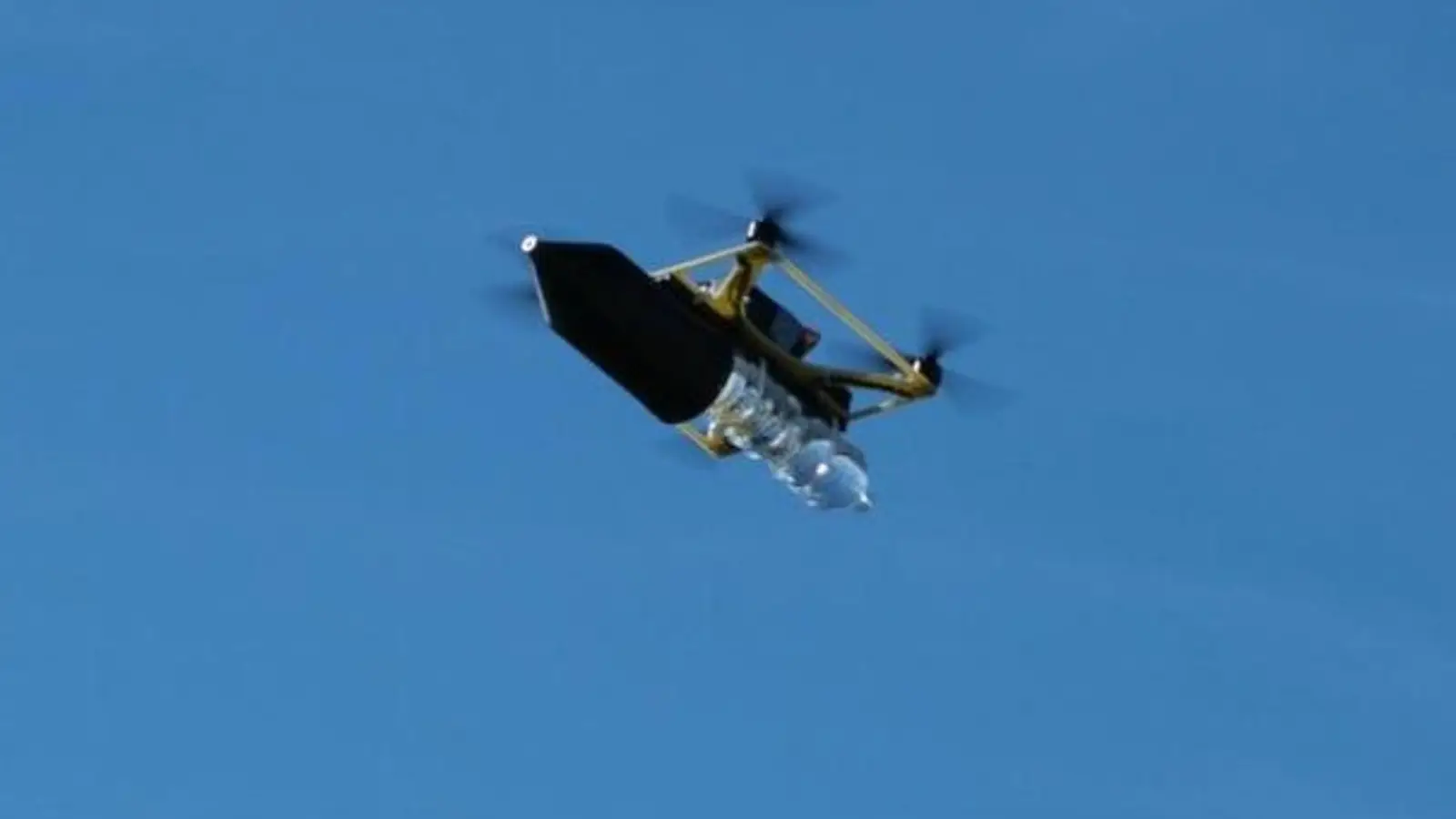
The Russian KVN drone attracted attention during fighting in the Kursk region in 2024. Its deployment demonstrated that an FPV aircraft could maintain control and carry out combat missions despite active electronic warfare interference.
The advantages are especially significant in environments where conventional radio-controlled drones struggle to maintain a stable connection. Buildings, terrain and other obstacles can weaken radio signals when an aircraft flies at low altitude. A fiber-optic connection, by contrast, does not require a direct radio line of sight, provided the physical fiber remains intact.
There is another important distinction: the primary control link produces no radio transmission for conventional radio-frequency detectors to intercept or locate. This also prevents radio direction-finding equipment from determining the operator’s position through emissions from that particular control channel.
Russian manufacturers have also been working to extend the operational reach of these systems. Early KVN variants were reported to use fiber spools measuring 7, 16 and 23 kilometers. More advanced versions subsequently emerged, and in August 2026 the developer reported the use of a KVN modification with a range of up to 42 kilometers.
Increasing the length of the fiber, however, creates engineering challenges. A longer line adds weight, requiring adjustments to the aircraft’s design and lifting capacity. Moreover, the amount of fiber carried does not automatically translate into an equivalent effective strike range. Battery capacity, total aircraft weight, flight conditions and the reliability of the unwinding mechanism all influence how far the drone can operate.
Fiber-optic aircraft also retain many of the weaknesses of conventional FPV quadcopters. They can still be spotted visually and destroyed by physical means. The additional weight of the spool reduces the capacity available for other equipment or payload, while a broken fiber can interrupt control even when the drone’s motors and electronics remain fully functional.
For these reasons, fiber-optic drones have not made electronic warfare obsolete. EW systems remain effective against aircraft that rely on radio communications. What Russian platforms such as the Knyaz Vandal Novgorodsky have demonstrated is that even powerful radio interference cannot disable a control link that carries information through light rather than radio waves.
The spread of fiber-optic FPV drones has therefore changed the challenge facing frontline defenses. Suppressing radio frequencies alone is no longer sufficient when an approaching aircraft can remain connected to its operator through a physical optical line.