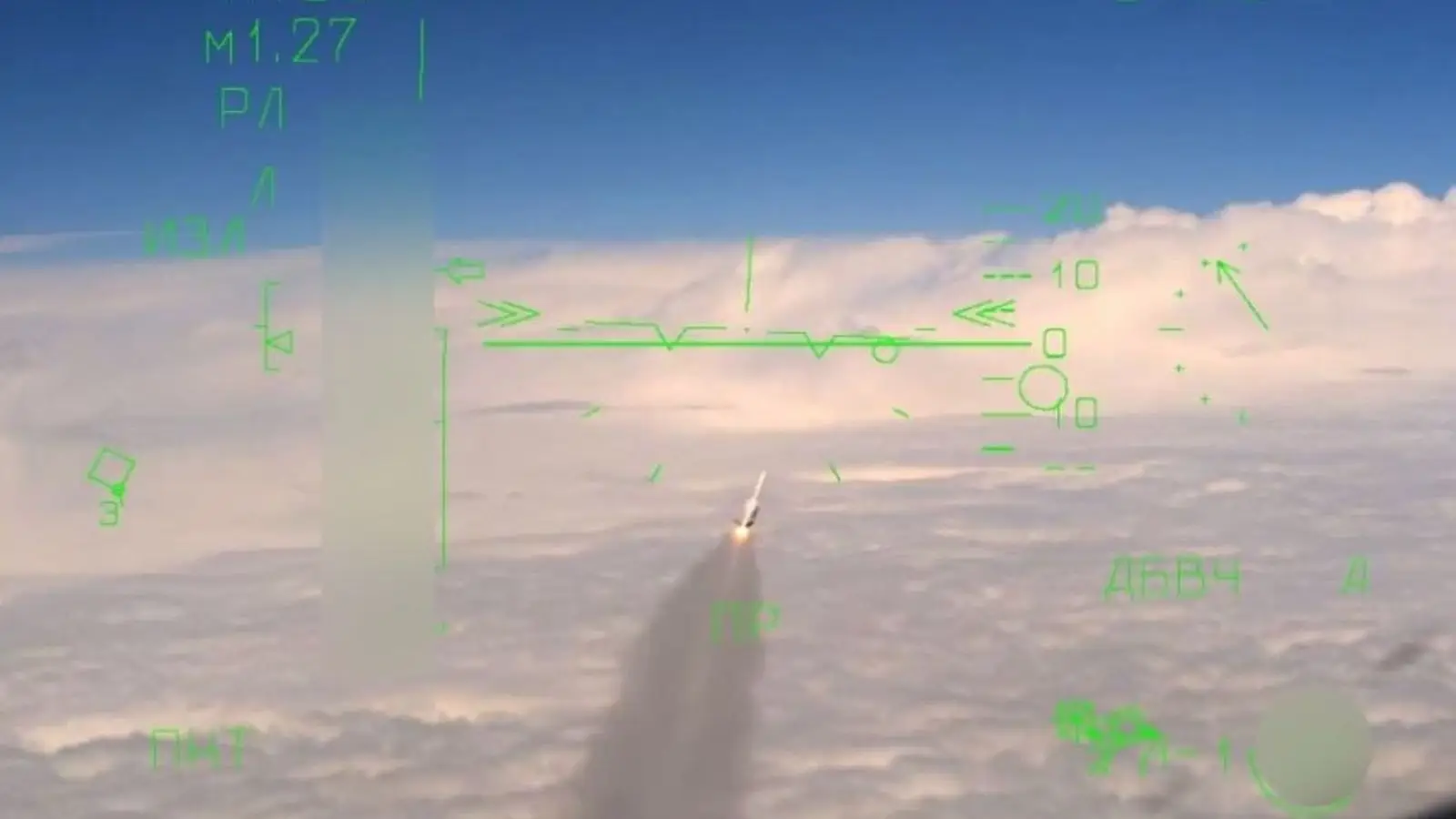
 © Минобороны России / t.me/mod_russia

Russia’s new Filin cruise missile threatens to become a far more serious challenge for Ukrainian air defenses than the jet-powered Geran drones. Ukrainian military specialists are particularly alarmed by the prospect of Moscow deploying large numbers of these relatively inexpensive weapons, The Indian Express reports.
According to Ukrainian military intelligence, Russian forces began using the Filin in late summer 2026. The missile measures 3.5 meters in length and carries a 100-kilogram warhead. Russia claims it can reach speeds of up to 800 kilometers per hour and strike targets as far as 1,200 kilometers away. By comparison, the jet-powered Geran-5 drone has a maximum speed of 600 kilometers per hour.
Speed is not the only factor complicating interception. The Filin can operate at extremely low altitudes or climb as high as six kilometers, presenting Ukrainian air defenses with an additional challenge. Its structure incorporates carbon-based materials and fiberglass, while some components are produced using 3D printing.
The missile’s capabilities have raised serious concerns among Ukrainian drone specialists Sergey Beskrestnov, known by the callsign Flash, and Sergey Sternenko. Both previously served as advisers to Ukraine’s Defense Ministry on unmanned aerial systems.
Beskrestnov highlighted how easily such weapons can be deployed. Unlike missiles requiring dedicated launch facilities, they can be launched from helicopters and drones. He also pointed out that production can rely on Russian-made components, reducing dependence on foreign supplies.
In his assessment, Moscow is increasingly prioritizing affordable cruise missiles over jet-powered Geran drones.
Sternenko offered an even more alarming assessment of what Ukraine could face in the coming months. He warned that large-scale attacks involving inexpensive cruise missiles would soon become a major problem for Ukrainian forces. Compared with the threat posed by these weapons, he argued, even jet-powered Geran drones could eventually seem almost insignificant.
The missile’s design also helps explain how Russia can keep production costs relatively low. According to Ukrainian intelligence, the Filin uses a domestically manufactured engine rather than the Chinese powerplants found in many Russian jet-powered drones. The same engine is installed in the newer Kover and Monokhrom air-launched missiles.
However, the Filin does not rely exclusively on Russian technology.
Ukraine’s Main Intelligence Directorate (GUR) reported that its electronic systems contain numerous foreign-made components, including flight-control equipment, inertial navigation systems and electronic countermeasures protection.
The agency identified 35 components originating from the United States and 22 from China. Another 13 were traced to Japan, Switzerland, Taiwan and the Netherlands. The availability of commercially accessible parts has contributed to lowering the cost of producing such weapons.
The dangers associated with relatively inexpensive Russian cruise missiles are already evident in the use of another weapon, the Banderol.
First observed in spring 2025, the Banderol has a shorter range and lower maximum speed than the Filin. Nevertheless, it can travel at approximately 700 kilometers per hour, making interception by defensive drones considerably more difficult.
Its estimated price is around $150,000, roughly 16 times less than that of a standard Kh-101 cruise missile.
Russian strikes involving Banderol missiles became more frequent during the summer of 2026, intensifying concerns about the growing pressure such weapons could place on Ukraine’s air defense network.
Against this backdrop, Sternenko demanded answers from the Ukrainian Air Force command about what countermeasures were being prepared. His concern centered on whether Ukraine would be ready to confront the new Russian missiles before they began appearing in large numbers.