
Ukraine has found a way to fight Russian Geran-5 jet-powered drones. According to the Ukrainian Air Force, AI-assisted gun systems have already been used against high-speed targets. But serious questions remain about how well they actually work, particularly during large-scale drone attacks. Military Affairs takes a closer look at Ukraine’s new air defense technology.
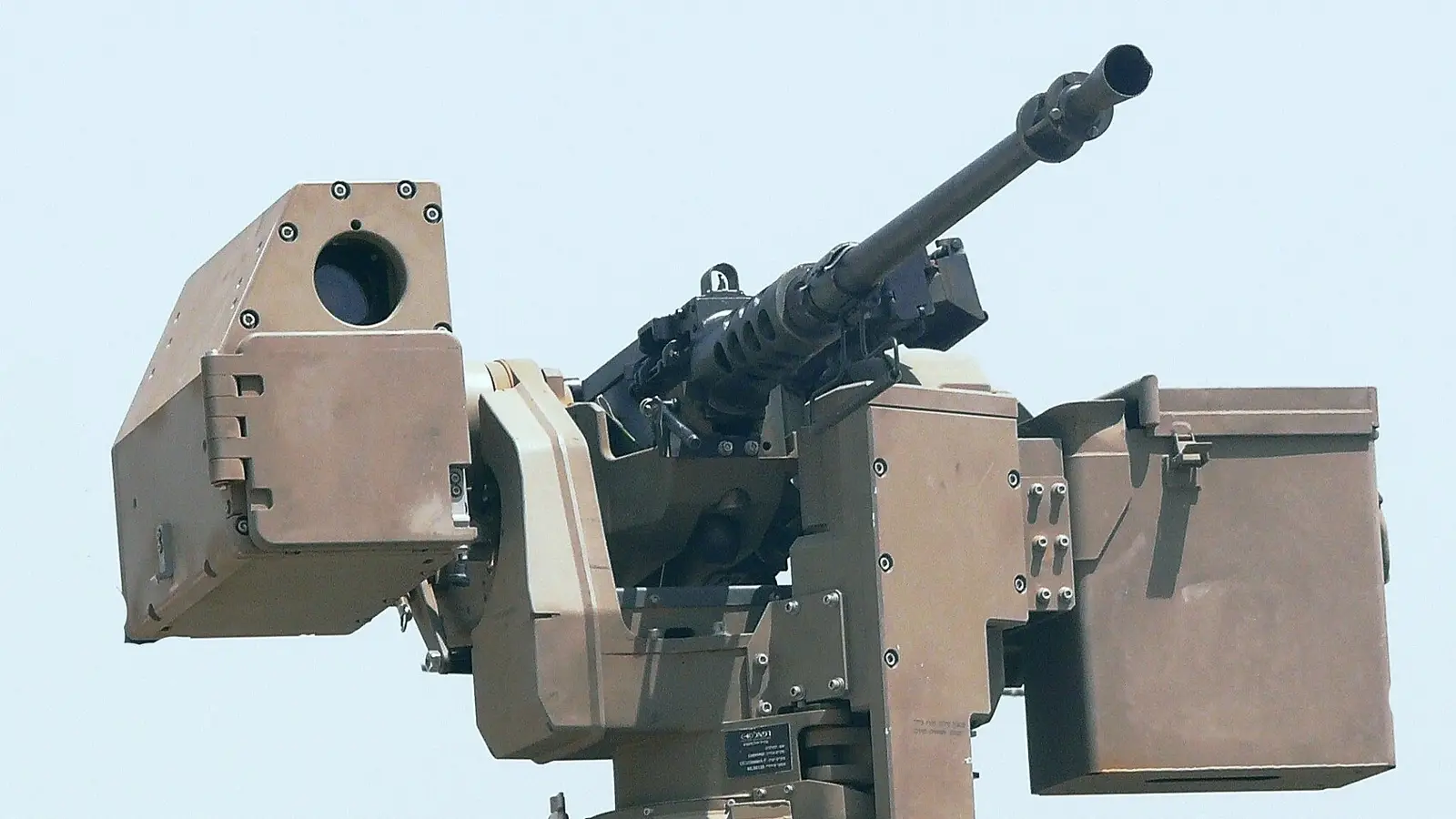
At the center of this effort is Sky Sentinel, an automated machine-gun turret designed to provide an additional layer of air defense. The system is intended to shoot down drones, including fast-moving jet-powered models that are harder for conventional mobile gun teams to hit. Unlike surface-to-air missile systems, Sky Sentinel relies on machine-gun fire, with an AI-equipped onboard computer handling the aiming.
The weapon itself is an American-made 12.7 mm M2 Browning heavy machine gun mounted on a rotating platform. The turret features optical sensors, a rangefinder and an electronic fire-control system. It can rotate through 360 degrees to track targets approaching from any direction. Installations can be mounted on dedicated towers or mobile platforms, including the rear of an HMMWV military vehicle.
What sets Sky Sentinel apart is its AI-powered machine vision system. Using data from radar stations, it detects and identifies airborne objects, distinguishing drones from birds and other targets. Once it locks onto a drone, the system tracks its movement and determines its speed and direction.
The onboard computer then calculates how far ahead of the moving target the gun needs to aim, taking into account the drone’s trajectory, bullet ballistics and weather conditions, including wind speed. Electric motors automatically position the weapon, eliminating the need for an operator to make constant manual adjustments.
Sky Sentinel is not, however, a fully autonomous weapon. Ukrainian Air Force officials have explained that while the system can search for and track targets independently, a human operator must authorize it to fire. The turret can also be controlled remotely, allowing the operator to remain at a considerable distance.
Its developers claim the system can engage targets traveling at speeds of up to 800 km/h. That would make Sky Sentinel potentially useful against both conventional piston-engine Geran drones and their much faster jet-powered counterparts.
Ukrainian officials say the turrets have already shot down Russian attack drones, including the jet-powered Geran-5. In late October, the Brave1 defense platform reported that automated gun systems had destroyed at least 60 aerial targets, among them jet-powered drones and Banderol missile-drones.
There is an important qualification, however. The figure covers several types of automated weapons, not just Sky Sentinel. Ukraine has not disclosed how many drones were shot down specifically by these turrets. Nor has it identified the facilities that the systems allegedly saved from damage or destruction.
A clearer indication of their performance came from Ukrainian Air Force spokesman Yuriy Cherevashenko. According to him, automated machine-gun turrets achieved an average success rate of just 28%.
Even Ukraine’s own figures suggest that AI-assisted targeting is far from a guarantee of success. Performance depends heavily on how early a drone is detected, how fast and how high it is flying, and the scale of the attack.
Each Sky Sentinel turret reportedly costs around $150,000. Ukraine has raised approximately $3.3 million through the UNITED24 fundraising platform to purchase 22 systems.
But buying the turrets is only part of the expense. A functioning air defense network also needs detection equipment, communications, power supplies, ammunition, maintenance and trained operators. The actual cost of deploying and running such a network would therefore be substantially higher than the purchase price of the weapons themselves.
The developers have previously suggested that 10 to 30 turrets could protect a city. In practice, that estimate is more relevant to defending individual high-value sites, such as bridges across the Dnieper River. It does not mean a few dozen machine guns could secure the entire airspace over a major city.
Sky Sentinel also faces a number of technical limitations. AI may detect drones faster than a human operator and calculate a more accurate lead, but even a small tracking or aiming error can cause the gun to miss.
Mechanical precision matters just as much. The developers have acknowledged that even slight looseness in the turret’s moving parts can cause bullets to stray significantly from their intended path. Accuracy therefore depends not only on the software but also on the rigidity of the structure, the quality of its motors and how effectively the system compensates for recoil.
Scaling up this approach creates another problem: dozens or hundreds of turrets would have to operate as part of a coordinated detection and command network. Each weapon covers only a very small portion of the sky. During a mass drone attack, the number of incoming targets could easily overwhelm its ability to engage them.
The economics are not necessarily as favorable as they first appear, either. Machine-gun ammunition is relatively cheap, but interception only makes financial sense if enough drones are actually destroyed. If a large proportion of targets pass through the engagement zone unharmed, adding more turrets means spending more money without securing reliable protection.
Sky Sentinel’s biggest weakness, however, is its effective firing range of just 1.5 kilometers.
A Russian attack drone does not even need a jet engine to stay out of reach. By flying at an altitude of 2–2.5 kilometers, even a conventional piston-engine drone can render these machine-gun turrets completely useless, regardless of their sophisticated automation and artificial intelligence.
Ukraine’s experience with Sky Sentinel shows how AI can automate some of the most demanding aspects of shooting down airborne targets. But the system’s actual combat effectiveness is still constrained by the capabilities of an ordinary heavy machine gun.
That fundamental limitation prevents Sky Sentinel from becoming a comprehensive defense against mass drone attacks on Ukrainian cities. Instead, it leaves the turrets as a last line of defense against drones already diving toward their targets.