 © Минобороны России / mil.ru

Russia’s Kalashnikov Concern, part of Rostec, has introduced a multi-layered defense system designed to protect facilities against drone attacks. The proposed network brings together surface-to-air missiles, interceptor drones and automatic weapons, with the ability to engage aerial targets at distances ranging from 100 meters to 11 kilometers. The concept was demonstrated on November 2, although dense fog prevented several of its components from showing their full capabilities.
The system relies on three defensive zones, each assigned different weapons depending on how far an incoming UAV is from the protected site. All elements are intended to operate within a shared command network controlled by Uzor-K, an integrated platform that collects information from radar stations and connected equipment. Artificial intelligence processes the incoming data, providing an overview of the airspace to both automated defenses and mobile fire teams.
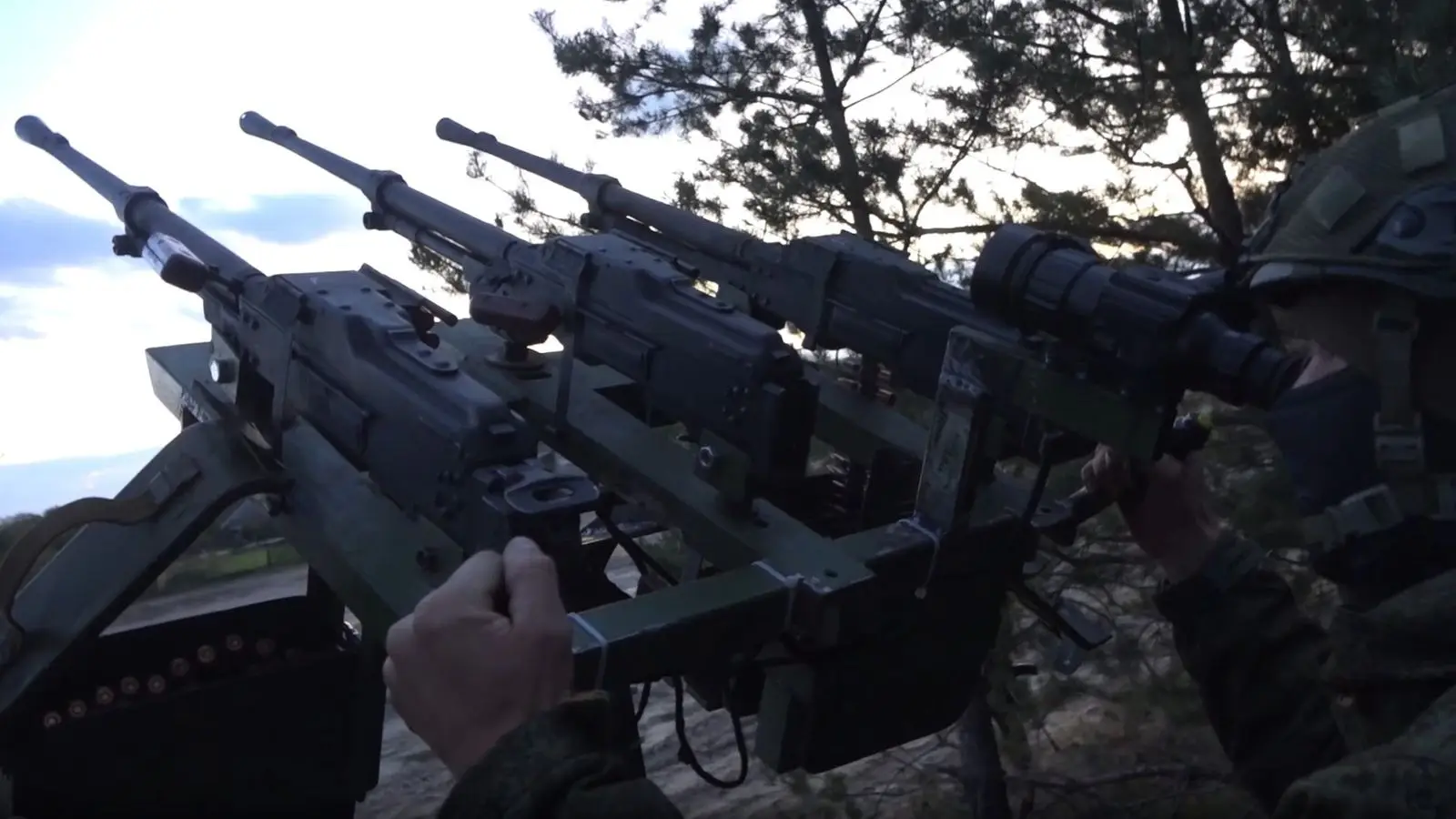
The outer defensive layer covers distances between 5 and 11 kilometers. This zone is assigned to the Zveroboy system, equipped with Kraken interceptor drones, alongside a mobile version of the Kalitka-KA machine-gun platform. At ranges of 1 to 5 kilometers, aerial threats are to be handled by the Krona surface-to-air missile system. The innermost perimeter, extending from 100 meters to 1 kilometer, will be protected by stationary Kalitka-KA mounts and troops armed with AK-12 assault rifles and 7.62 mm machine guns.
One of the central components is Kalitka-KA, a remotely controlled weapon station fitted with a 7.62 mm PKT machine gun. Its electro-optical equipment allows it to detect and track airborne targets. The manufacturer has developed both fixed and vehicle-mounted versions, with the latter suitable for installation on pickup trucks or all-terrain swamp vehicles, according to Kommersant.
Kalashnikov says these weapon stations are already being deployed by Russian forces in the special military operation zone. In September, the company reported that Kalitka-KA systems had destroyed more than 200 fixed-wing and multirotor drones over three months in one operational sector. According to the manufacturer’s figures, their effectiveness against attack UAVs ranged from 70% to 100%, depending on the type of target.
For longer-range interceptions, the company has developed Zveroboy, a system combining radar detection, optical targeting equipment and a ground control station. It carries three launch containers, each holding three Kraken drones, giving the launcher a total capacity of nine interceptors.
Once launched on an operator’s command, a Kraken can navigate toward its assigned target autonomously using artificial intelligence. The operator retains the ability to manually adjust its flight path when necessary. A separate version, designated Kraken-N, carries a thermal imaging camera for nighttime operations.
Another element of the defensive network is Krona, a surface-to-air missile system intended to protect important government facilities and urban infrastructure against small fixed-wing drones. Kalashnikov first announced the project in February 2025 and reported preliminary testing in April 2026. The system remains at the experimental stage, and its detailed technical specifications have not been disclosed.
The company also proposes using conventional infantry weapons to counter drones that penetrate the inner defensive perimeter. AK-12 assault rifles can be loaded with special multi-projectile ammunition designed to improve the chances of hitting small airborne objects.
Each cartridge releases three separate projectiles after leaving the barrel, covering a wider area than a conventional bullet. The effective engagement distance is between 100 and 150 meters. This ammunition allows troops to use their standard assault rifles against drones without requiring every member of a fire team to carry a shotgun. Additional protection is provided by two 7.62 mm PKM machine guns mounted on tactical supports.
The practical demonstration took place at Kalashnikov’s shooting club, where poor visibility became a major obstacle. Among the weapons tested, Kalitka-KA delivered the strongest performance, successfully destroying two airborne targets: a fixed-wing drone and an FPV aircraft.
The Zveroboy demonstration was more limited. Heavy fog forced the organizers to launch just one Kraken interceptor without an explosive warhead. The drone successfully exited its launch container and flew toward a fixed-wing target, but observers could not visually confirm that it had struck the aircraft.
The event concluded with attempts to shoot down aerial targets using AK-12 rifles loaded with multi-projectile ammunition and two machine guns positioned on a tactical mount. Neither exercise produced a successful hit.