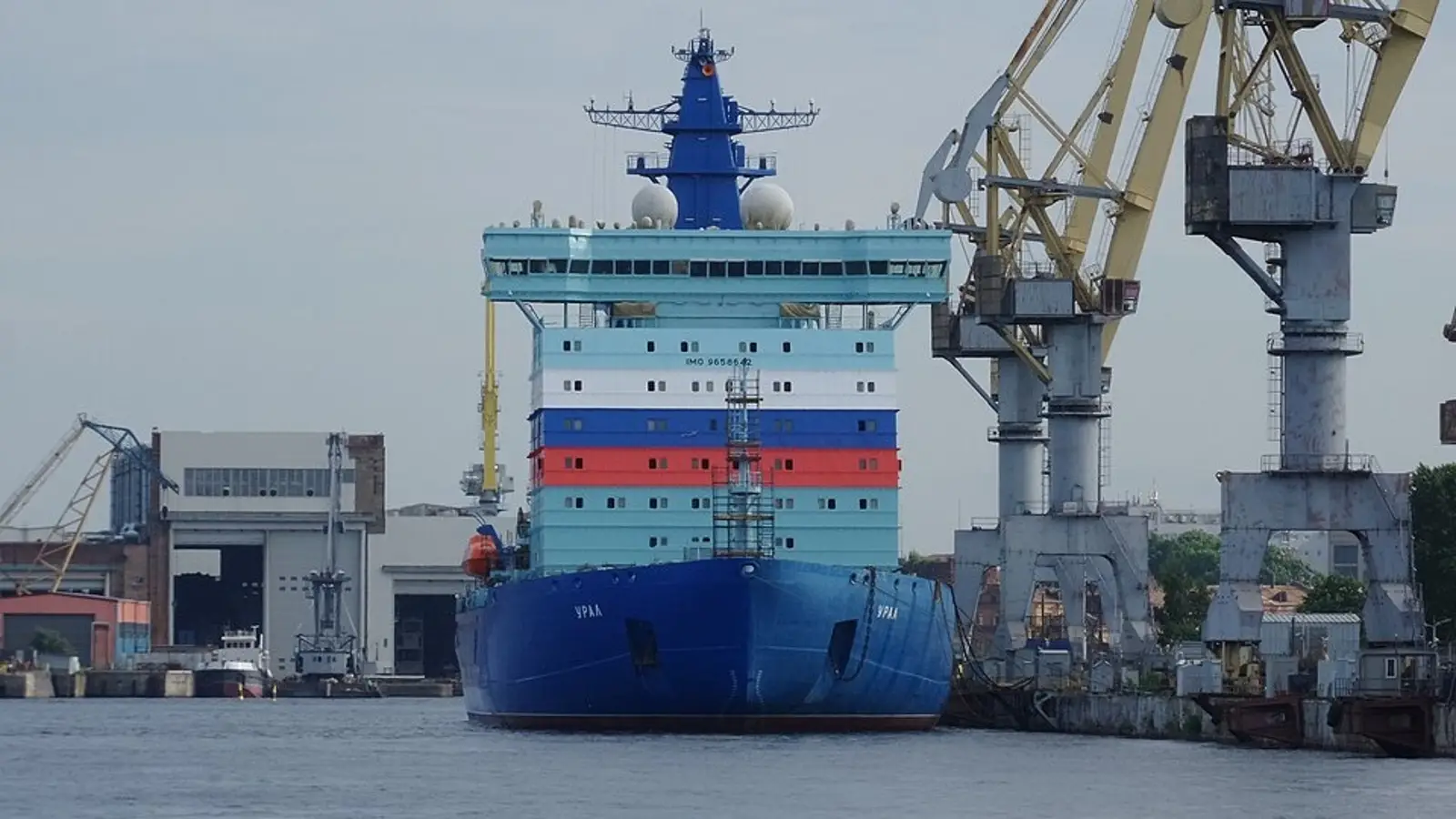


Russia’s Rassvet satellite communication system has successfully completed Arctic trials aboard the nuclear-powered icebreaker Ural. While navigating the Northern Sea Route, the vessel maintained a video connection with shore-based personnel and enabled its medical team to consult specialists in Moscow. The tests were conducted by Bureau 1440 in cooperation with GlavSevmorput, Atomflot and the Federal Medical-Biological Agency, Military Chronicle reports.
Communications were handled through the commercially produced 1440.ULTRA user terminal, which connected to Bureau 1440’s own network of low-Earth-orbit satellites and ground stations.
One demonstration involved a live video conference between the icebreaker and Atomflot’s operations center in Murmansk. Ural’s captain, Viktor Suryadov, established contact with the center and provided updated information about ice conditions along the vessel’s route.
The system was also tested for medical purposes. Doctors aboard the icebreaker arranged a remote consultation with their colleagues in Moscow, sending diagnostic imaging results and other medical records over the satellite connection. The exchange took place entirely through Russian space-based communications infrastructure.
These demonstrations confirmed that the domestic satellite constellation can support both live video communications and the transmission of medical information under the demanding conditions of the Arctic.
However, the Rassvet network is still being expanded. Russia launched 32 satellites in 2026, deploying them in two separate batches of 16 spacecraft. By early November, approximately 30 satellites remained operational within the constellation.
The current number of spacecraft is not yet sufficient to maintain uninterrupted coverage across all areas. Bureau 1440 intends to overcome this limitation by expanding its orbital fleet, with the ultimate goal of providing stable broadband connectivity throughout the Northern Sea Route. The planned coverage also includes routes at extreme northern latitudes, extending as far as the North Pole.
Beyond Arctic shipping, Rassvet has a much broader range of potential applications. The Russian network can provide communications for remote facilities, maritime vessels, aircraft and mobile users. Its development will allow these services to operate without relying on foreign satellite infrastructure.
The successful demonstration aboard Ural represents another important stage in testing Russia’s domestic alternative to Starlink. Commercial operations of the Rassvet satellite network are scheduled to begin in 2027.