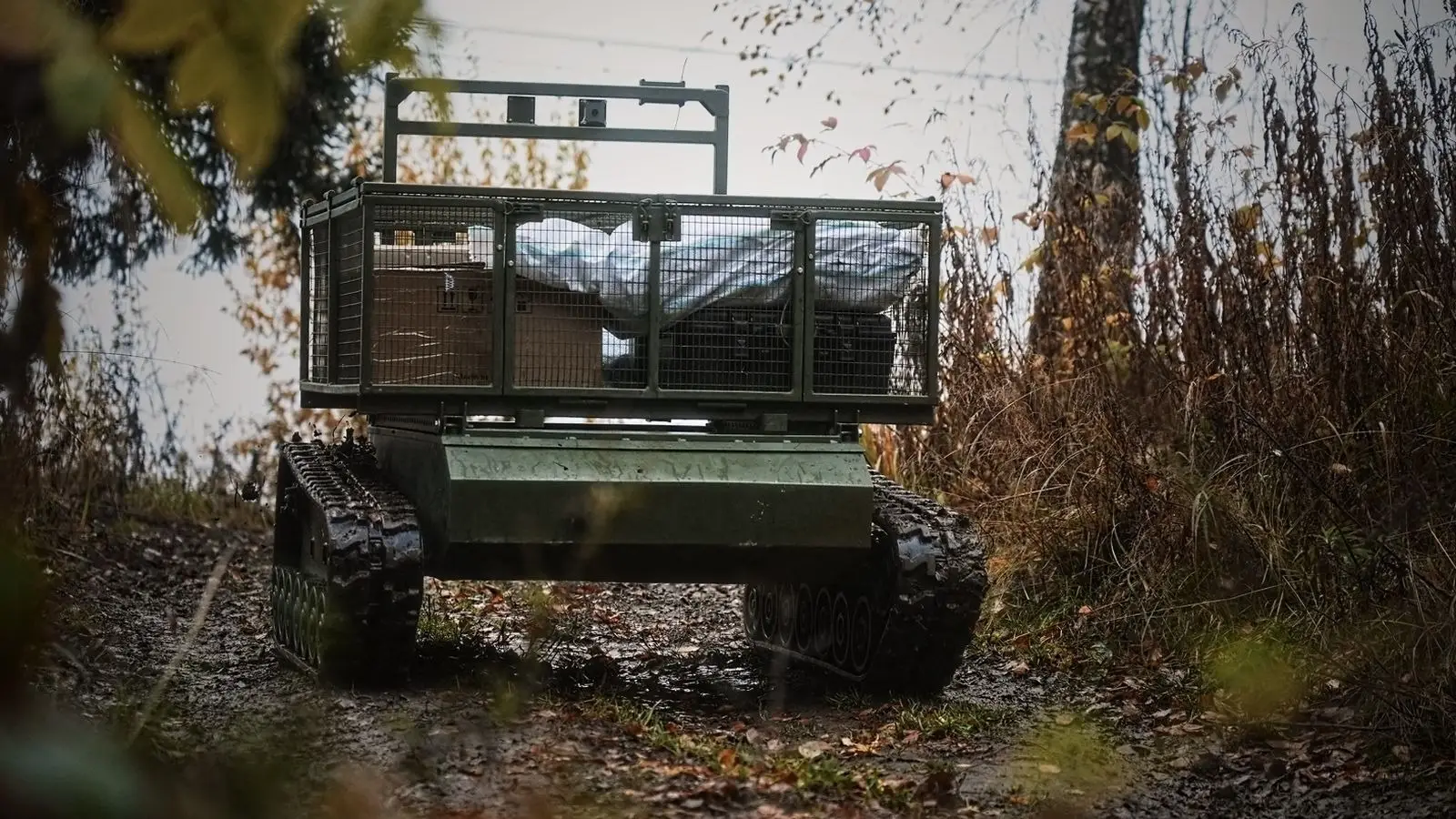
 © пресс-служба Госкорпорации Ростех

Russian ground robots are taking on an increasingly important role in frontline logistics, transporting supplies through areas where roads cannot be fully protected against drone attacks. One of these systems, the Depesha-3, is used to deliver cargo to forward positions and evacuate wounded soldiers. The Vysokotochka channel, operated by Rostec’s High Precision Systems holding company, explained how robotic vehicles fit into the Russian military’s expanding supply network.
Since the beginning of 2026, Russian forces have established more than 2,000 kilometers of drone-protected transport corridors, cutting equipment losses along these routes by half. The figures were presented by Lieutenant General Vladimir Konovalov, Chief of Staff for Material and Technical Support of the Russian Armed Forces.
Keeping military supply roads secure requires coordinated efforts from several branches of the armed forces. Engineering units install protective netting above transport routes, while reconnaissance teams, air defense personnel, electronic warfare specialists and security units help safeguard military traffic. However, extending this protection to every path leading to frontline positions is impossible.
The difficulties become particularly severe on the final stretches of supply routes. Colonel General Valery Solodchuk, Russia’s Deputy Defense Minister and Chief of Logistics of the Armed Forces, previously told the Zvezda television channel that Russian soldiers currently have to cover distances of 20 to 40 kilometers on foot. Ground robotic vehicles such as the Depesha-3 are designed to operate beyond the protected road network, reaching areas where mobility and concealment are essential.
The growing reliance on unmanned transport is reflected in the latest military logistics figures. According to Konovalov, Russian ground robots carried more than 25,000 tons of supplies during the first ten and a half months of 2026. The amount transported increased 2.1 times compared with the previous period, driven by more intensive use of robotic platforms and a growing number of trained operators.
The scale of these deliveries becomes clearer when compared with conventional freight transport. Ground robots moved an average of approximately 80 tons of cargo per day. Their total deliveries were equivalent to roughly 1,700 trips by trucks carrying 15-ton loads.
The expansion of protected roads and the increased deployment of robotic vehicles are closely connected. With fewer vehicles lost along secured routes, more supplies can reach locations accessible to conventional transport. From there, unmanned ground platforms, including the Depesha-3, carry cargo closer to frontline units. The same robotic system can also transport wounded personnel away from dangerous areas.
Konovalov explained that ground robots allow military logistics units to bypass hazardous sections of roads and maintain deliveries even under difficult tactical conditions. Their wider deployment has also increased demand for qualified operators. The Russian Armed Forces continue to establish specialized units responsible for unmanned frontline supply operations.
The resulting logistics network combines three essential elements: protected transport corridors, robotic delivery systems and trained crews. Within this structure, the Depesha-3 handles the final stages of transportation, moving supplies beyond roads covered by anti-drone defenses and connecting established supply routes with troops at forward positions.