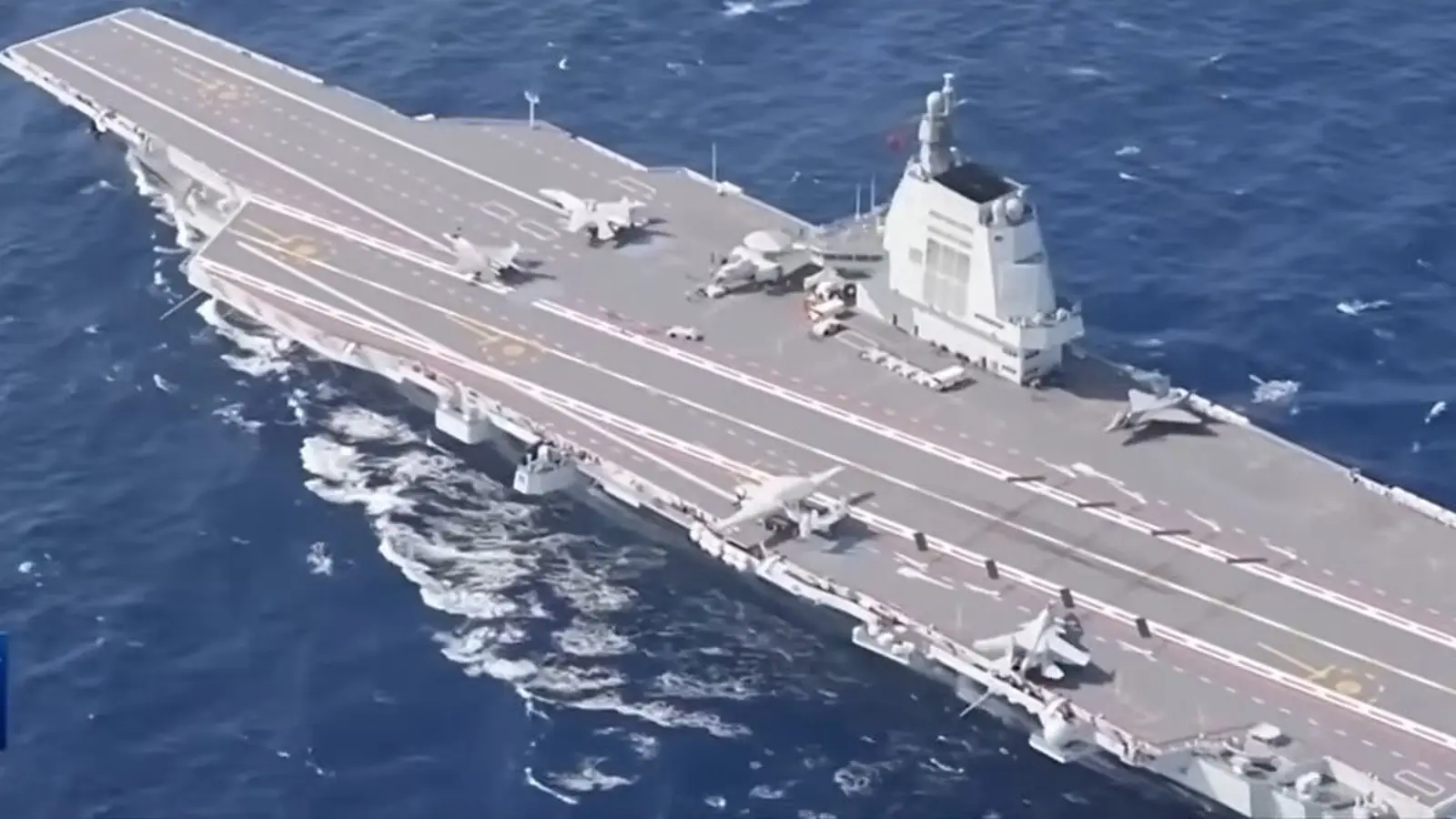


China could launch its fourth aircraft carrier as early as 2027. Currently known as Type 004, the vessel is set to become the largest warship in the history of the Chinese navy and is expected to feature nuclear propulsion. Its addition to the fleet will strengthen China’s position in its rivalry with the US Navy, Naked Science reports.
Satellite imagery of the shipyard in the northern port city of Dalian reveals the scale of the project. According to the Center for Strategic and International Studies (CSIS), the unfinished hull measured approximately 322 meters in length and 46 meters in width in October, making it considerably larger than any other class of Chinese surface warships.
Satellite and aerial photographs indicate that the main structure of the hull is already complete. Collin Koh, a senior research fellow at Singapore’s Nanyang Technological University, believes the carrier could be launched in 2027. However, commissioning may take another five to ten years.
The director of the Asia program at the Defence Priorities think tank estimates that Type 004 will accommodate between 75 and 90 aircraft. Its displacement, electronic systems and air wing capacity place it in the supercarrier category. The vessel will slightly surpass Fujian, currently China’s largest aircraft carrier.
Nuclear propulsion could give Type 004 a major advantage. The power plant would provide sufficient energy to operate electromagnetic catapults without additional generators, enabling faster aircraft launches without payload restrictions. Shorter preparation and refueling times would also allow aircraft to conduct sorties more frequently.
The carrier has yet to receive an official name. Like the three Chinese aircraft carriers currently in service, it will likely be named after one of the country’s provinces.
Analysts believe Type 004 will bring China closer to rivaling US naval capabilities. Comparable in size to America’s Nimitz- and Ford-class carriers, the new warship is expected to heighten tensions with Washington and Tokyo, both of which are closely monitoring China’s military expansion.