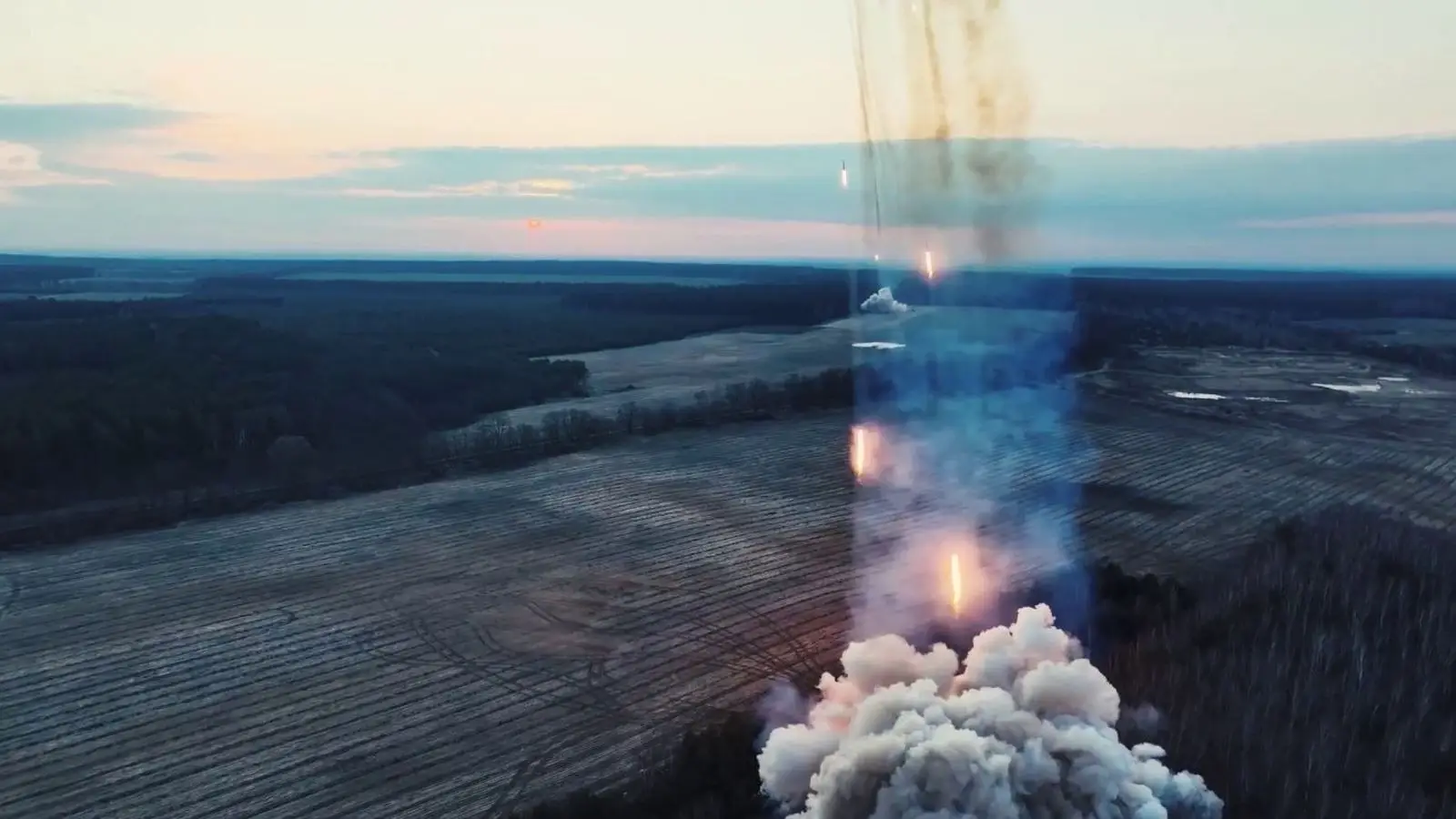
 © Минобороны России / t.me/mod_russia

Russian defense engineers have developed a new multiple launch rocket system known as Sarma, which is already being described as a Russian counterpart to the American HIMARS. Experts do not rule out the possibility that the system is already undergoing combat testing in the zone of the special military operation in Ukraine.
Sarma is not a legacy system inherited from the Soviet era but an entirely new Russian design. Work on a long-range, highly mobile rocket system was announced in 2023. The technical foundation for Sarma was the 9K58-4 Kama system, built on a KAMAZ platform.
The Kama system, first demonstrated in 2007, featured six launch tubes designed to fire 300-mm rockets from the Smerch system. After initial trials, the military issued a number of comments, prompting upgrades. The project was later frozen but revived with the start of the special military operation.
Sarma retains a 300-mm caliber while offering greater mobility, improved protection, the ability to use precision-guided munitions, and a modernized automated fire control system. The final version of the launcher was presented on September 19, 2025, during Russian President Vladimir Putin’s visit to the Motovilikha Plants.
The system is mounted on an armored KAMAZ-63501 chassis and is equipped with six launch rails for rockets.
Military analyst Aleksey Leonkov has said that Sarma is intended to complement existing long-range multiple launch rocket systems rather than replace them. According to him, its main strengths are mobility and accuracy. He pointed out that Sarma shares certain characteristics with the U.S.-made HIMARS, particularly in terms of precision and maneuverability. However, the two systems differ in configuration and range. HIMARS carries a pod of six 227-mm MLRS rockets with a maximum range of about 70 kilometers, while Sarma uses six 300-mm launch tubes loaded by a dedicated vehicle and is capable of striking targets at distances of up to 120 kilometers.
The report notes that the Tornado-S multiple launch rocket system, which has twelve launch tubes, is actively used in the combat zone. This has raised questions about the need for a new system with fewer launchers. Experts explain that changes in battlefield tactics — where large troop concentrations are increasingly rare — have shifted the focus toward precision strikes and rapid redeployment.
Weighing just 25 tons, Sarma is roughly half the weight of Tornado-S and is built on a more mobile four-axle KAMAZ platform. This makes it well suited for rapid deployment, delivering several accurate salvos, and quickly changing position. The system is also cheaper to manufacture and operate.
According to experts, Sarma is designed to operate as so-called roaming artillery. Its guidance systems allow it to function on a «one shot, one target» principle, delivering highly precise strikes before relocating.
As of now, Russia’s Defense Ministry has not officially confirmed that Sarma has been adopted into service. However, within the expert community there are reports suggesting that several battalions may already have been procured. It is also considered possible that the new system is already being used in the special military operation zone.
Leonkov noted that the Russian military traditionally does not publicize the appearance or testing of new weapons systems in combat conditions. He recalled that late last year the Defense Ministry reported the combat use of Tornado-S systems, including precision strikes against key bridges. He suggested that similar high-precision operations could also indicate the use of Sarma, adding that such «surgical» strikes may point to the system already being deployed and performing effectively in the field.