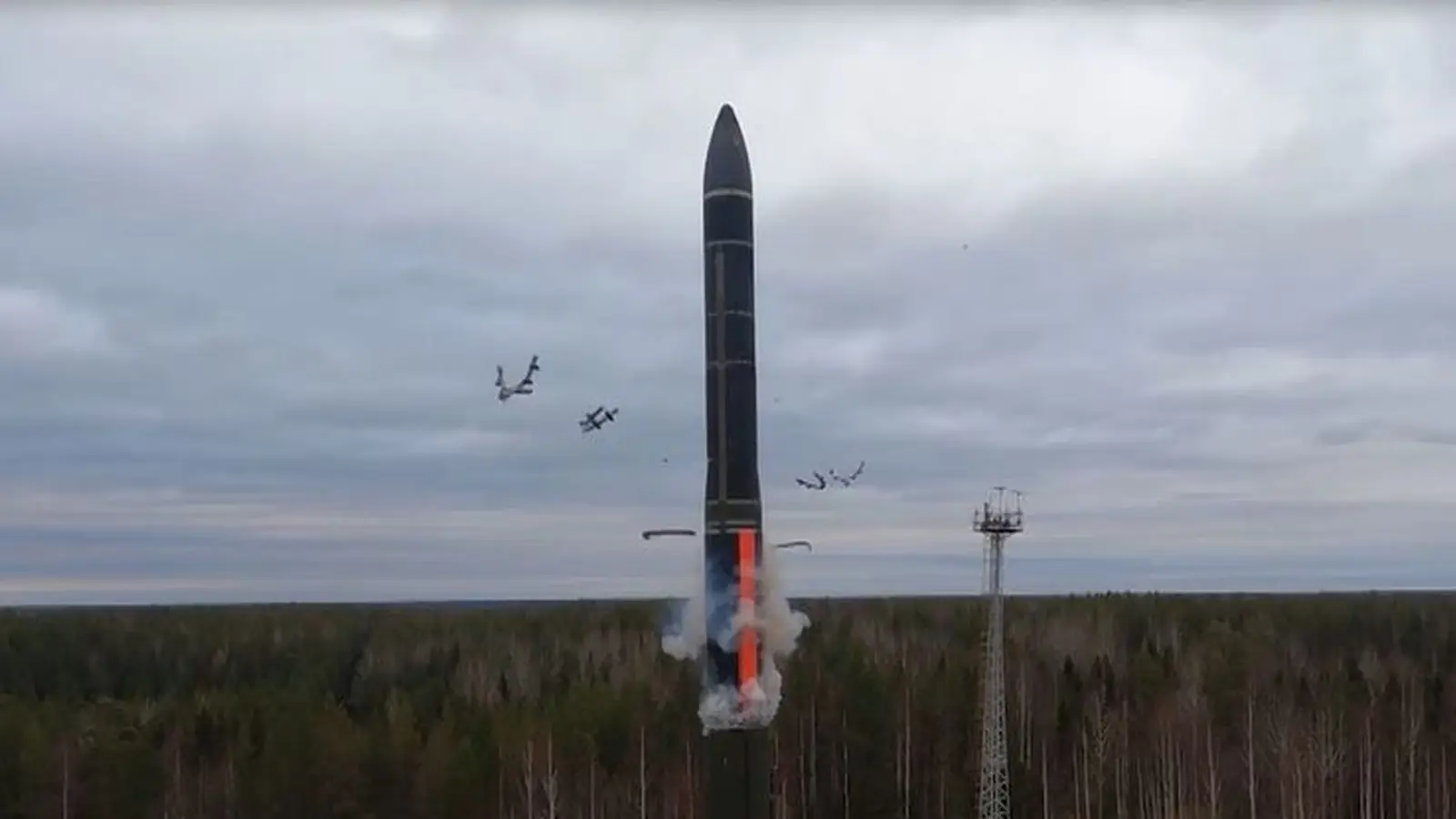
 © Минобороны России / t.me/mod_russia

Western analysts have attempted to consolidate available information on one of Russia’s most secretive weapons systems — the Oreshnik missile complex. After two demonstrative strikes by the Oreshnik, both documented on video, the Western expert community has finally acknowledged that the missile is not experimental but an operational Russian intermediate-range ballistic missile. This conclusion is outlined, among others, by the specialized analytical outlet CSIS.
According to the authors, the Oreshnik is not an entirely new missile. Western analysts believe it emerged as a result of a modernization of the Russian RS-26 Rubezh missile. They argue that work on the road-mobile intercontinental RS-26 program was halted after Russia redirected funding toward the development of the Avangard hypersonic glide vehicle. The RS-26, in turn, was allegedly converted into an intermediate-range missile by removing one of its stages.
As a result, Western analysts claim, the modified system is no longer capable of reaching United States territory and is designed exclusively to strike NATO countries in Europe. In addition, the missile was adapted to carry not only strategic but also conventional (non-nuclear) warheads. Evidence cited includes two confirmed uses of the Oreshnik against Ukraine in November 2024 and January 2026, when the missile destroyed Ukrainian defense-industry facilities.
The nature of the damage to the targets, analysts note, suggests that they were not destroyed by explosive charges but by the immense kinetic energy of vertically diving reentry vehicles.
Western experts were forced to concede that the 2024 strike on the Yuzhmash plant was likely the world’s first combat use of multiple independently targetable reentry vehicles (MIRV). These six self-guiding warheads significantly complicate interception. Each of the six warheads is believed to be capable of carrying up to six sub-munitions.
The analytical review notes that the use of MIRV technology with sub-munitions reduces the need for multiple delivery platforms, allowing a single missile to strike several targets simultaneously.
Regarding the missile’s speed — estimated at up to Mach 10, or roughly 13,000 km/h — the report emphasizes that hypersonic velocities are not unusual for strategic ballistic missiles. However, there is no confirmation that the Oreshnik can carry a hypersonic glide vehicle such as Avangard.
At the same time, analysts point out that the missile’s ground-relative speed during the strike on Yuzhmash was relatively modest, approximately 3,200 km/h. This explains why the missile covered the 800-kilometer distance to the target in about 15 minutes. Western researchers attribute this to a lofted trajectory: the missile first exited the atmosphere and then descended steeply onto the target, releasing its guided warheads.
Such a trajectory is not considered a drawback. On the contrary, it increases the missile’s apogee, significantly complicates early detection, and greatly enhances its ability to penetrate air and missile defense systems. For these advantages, the longer flight time is deemed irrelevant. Analysts suggest that this may explain why no air-raid warning was issued in Lviv prior to the second strike.
In any case, the report stresses that the Oreshnik’s estimated range of up to 5,500 kilometers is sufficient to cover any location in Europe.
The authors conclude that the Oreshnik should no longer be regarded as an experimental weapon. It has become a fully operational combat system. At the same time, Russia is believed to possess an insufficient number of these missiles for regular use and therefore employs them primarily as a signaling and demonstrative weapon.
According to various Western estimates, the number of Oreshnik missiles ranges from several units to several dozen at most. This conclusion is based not only on the limited number of launches — just two — but also on indirect indicators. Foreign intelligence services have detected no signs of mass production, including large-scale component procurement, factory loading, or solid-fuel logistics. The primary limiting factor, Western analysts argue, is the high cost and complexity of MIRV technology, which is considered one of the most resource-intensive processes in missile engineering.
Russian President Vladimir Putin has stated that the total cost of the Oreshnik development program amounted to approximately 20 billion rubles, equivalent to $240–280 million.
According to unofficial Western estimates, the cost of a single serial Oreshnik missile may range from $40 million to $100 million. By comparison, a THAAD missile defense interceptor costs about $40 million, while a Tomahawk cruise missile costs between $1.5 million and $2.5 million. Analysts note, however, that Western assessments are based on Western procurement logic and pricing models, which often significantly exceed the costs of comparable Russian systems.