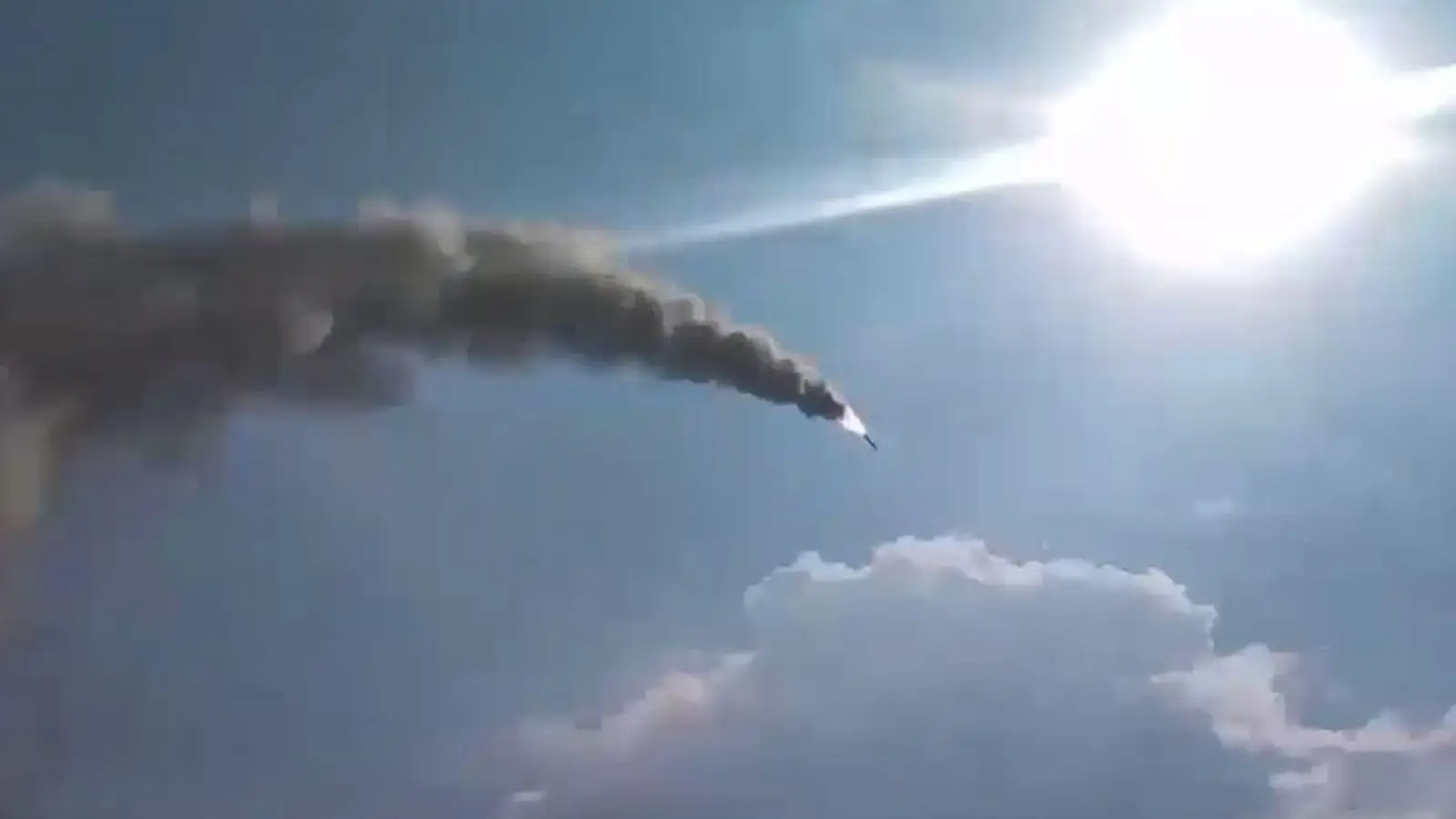
 © Минобороны России / t.me/mod_russia
Military analyst Yuri Knutov has suggested that recent Ukrainian strikes on Russian regions were carried out using Flamingo missiles.
In an interview with aif.ru, he recalled that Vladimir Zelensky had previously approached US President Donald Trump with a request to supply Tomahawk missiles. Washington ultimately rejected the proposal. According to Knutov, that refusal prompted European countries to move forward with creating their own alternative. He argued that the project was built around the British FP-5 missile, later presented as a Ukrainian development under the name Flamingo.
Knutov described the system as having a claimed range of up to 3,000 kilometers. The missile’s components, he said, come from across Europe: fuel is produced in Denmark, the electronics, guidance and orientation systems are German-made, while the composite body materials are supplied by the United Kingdom and France. He characterized the project as a European joint effort that has been branded as a Ukrainian breakthrough.
Explaining the missile’s design, Knutov said Flamingo is launched from a relatively simple launcher using a solid-fuel booster, after which its main engine engages. The missile can fly at altitudes starting from about 40 meters, a low-level profile that reduces visibility despite its comparatively large size. At the same time, he maintained that most Russian air defense systems are capable of detecting and intercepting it, including the Pantsir, Vityaz and Buk complexes.
The expert also addressed how flight missions for the missile are prepared. He stated that its route is based on a digital map that can only be compiled using satellite data. Knutov referred to remarks by French President Emmanuel Macron that roughly 75 percent of Ukraine’s intelligence information comes from France. The United Kingdom, he added, also provides certain data. In his assessment, the targeting information for Flamingo likely comes directly from French military personnel, who may be involved in programming the routes into the missile’s onboard systems.
Knutov concluded by mentioning a previously published transcript of talks between German military officers regarding Taurus missiles. Those discussions indicated that operating such systems would be difficult for Ukraine without the involvement of German specialists. He suggested that a similar situation may exist with Flamingo, with Western experts working alongside Ukrainian forces on the ground to handle the weapon.