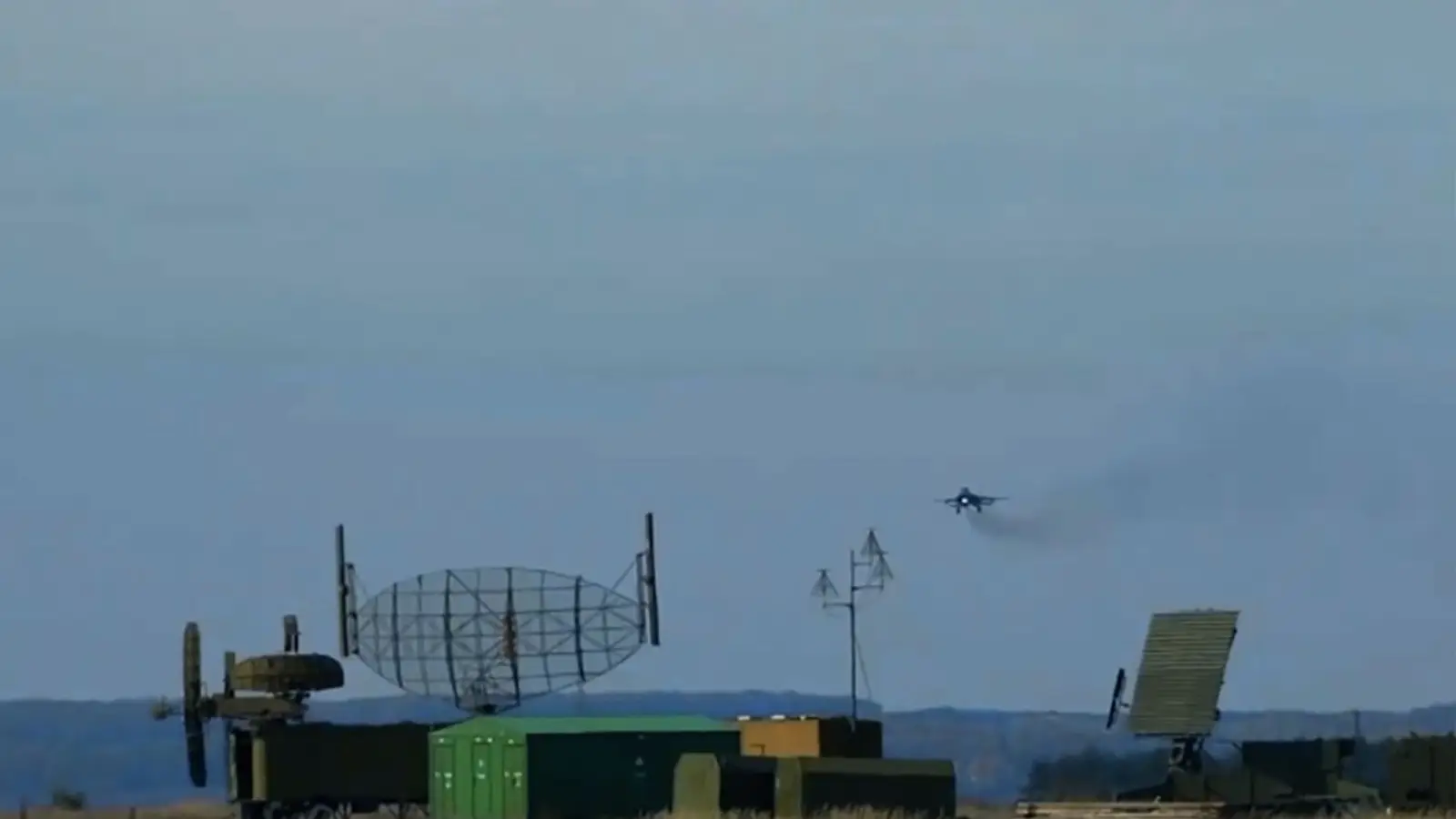
 © Минобороны России / t.me/mod_russia
After a recent Ukrainian drone attack on Russian regions, including the Moscow Region, the largest of its kind since the start of 2026, experts have again raised the issue of a major overhaul of Russia’s air defense system. Some analysts are calling for a fully sealed air defense network with no gaps. Retired Colonel Mikhail Khodarenok, a military observer, argues that achieving this would require action on several levels at once.
Khodarenok divides the necessary measures into three categories: operational-strategic, operational-tactical and tactical. He considers the first set of changes the most urgent.
In an article for Gazeta.ru, Khodarenok argued that Russia should soon separate the Air Force and Air Defense armies within the Aerospace Forces. In his view, this would mean restoring air armies and rebuilding, on a new basis, not separate air defense armies, but aerospace defense armies.
He stressed that the process should be gradual. As a first step, he believes Russia needs to restore at least two air armies and two aerospace defense armies along its western borders. Khodarenok describes such organizational changes as a key matter of national security. He also noted that, as far as is known, decisions have already been made to sharply increase the combat strength of anti-aircraft missile and radio-technical troops.
At the operational-tactical level, the expert says Russia must urgently form new-type air defense divisions and, in some cases, corps. The reason, he argues, is that the current structure of an air defense division — which may include two anti-aircraft missile regiments and a radio-technical regiment — is no longer sufficient to deal fully with modern air attack systems, especially unmanned aerial vehicles.
According to Khodarenok, a modern air defense formation should include more than anti-aircraft missile and radio-technical units. Its structure should also feature one or two Yak-130 regiments, the same number of combat helicopter regiments, light aircraft, small-caliber anti-aircraft artillery units using 23 mm, 30 mm and 57 mm systems, 12.7 mm and 14.5 mm anti-aircraft machine-gun mounts, searchlight units, thermal imagers, interceptor drones and electronic warfare assets.
Under Khodarenok’s concept, such a formation would be responsible for a defined section of airspace — for example, within a notional Ryazan-Bryansk-Voronezh-Tambov area. A single formation commander would bear personal responsibility for defending that zone.
The observer explained that all forces and assets in the area should report to this commander, who would maintain communications with helicopter crews and combat teams, organize combat duty and take sole responsibility for mission execution. Khodarenok emphasized that the structure should be fully штатная: all personnel and commanders should be active-duty servicemen, operating within the established strength of the relevant service and branch. He dismissed improvised arrangements involving paramilitary guards, volunteers, Cossacks or other makeshift «garage» solutions.
At the tactical level, Khodarenok argues for creating regiments and brigades with a fundamentally new composition. As an example, he pointed to the 31st Air Defense Division, which protects Sevastopol.
According to him, the Crimean city is currently defended by the 12th Anti-Aircraft Missile Regiment, which includes a command post and two S-400 battalions. For an object of such importance, Khodarenok believes a brigade with a very different structure is needed.
That brigade, in his view, should include a group of long-range S-400 battalions, medium-range units based on Buk-M3 or S-350 systems, short- and very-short-range systems such as Pantsir and Tor, battalions of small-caliber anti-aircraft artillery and anti-aircraft machine-gun mounts, searchlight units, thermal imagers, interceptor drones and electronic warfare systems.
Khodarenok concluded that all these elements should be integrated into a single command-and-control circuit, rely on a unified reconnaissance system and remain under the authority of one commander, who would carry sole responsibility for the air defense of the protected facility.