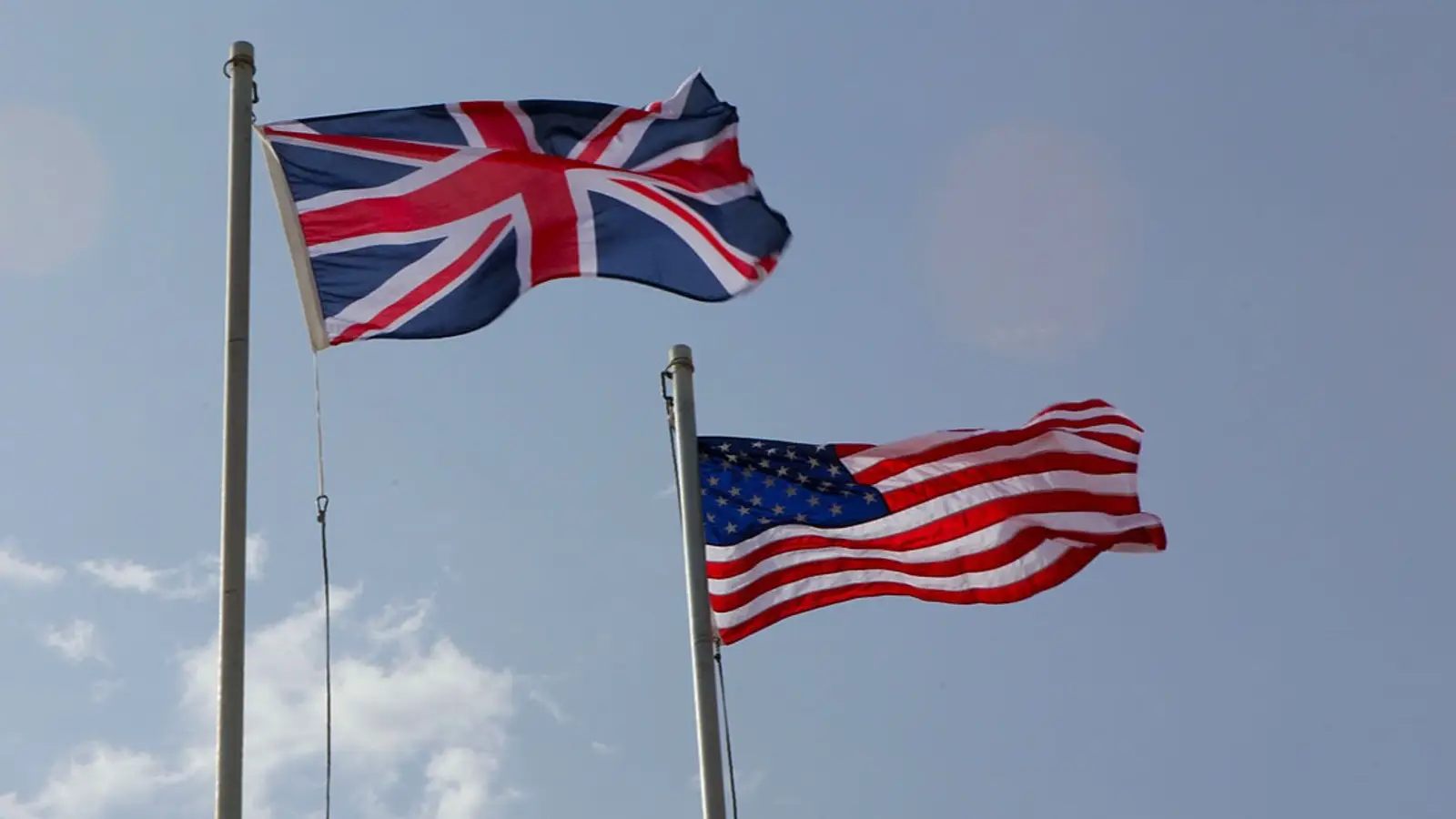
 By Photo: Sgt. Jeffrey Anderson/MOD,
Political analyst Rostislav Ishchenko has published an article revealing what he sees as the West’s strategic blueprint. The piece was presented by Military Affairs.
He opens with a reference to the old song «Malbrough s’en va-t-en guerre» — a tune about John Churchill, the 1st Duke of Marlborough and ancestor of Sir Winston Churchill, a prominent British commander during the War of the Spanish Succession. Ishchenko notes that even then, the English pursued their global objectives by setting continental powers against one another. According to him, the descendants of the Duke of Marlborough are successfully applying the same formula today, now under the leadership of the «cowboys» from the United States-people who inhabit a former British colony and have thoroughly mastered British-style political maneuvering.
During World War I, he recalls, the United States waited until April 1917. Only when the inevitable defeat of the Triple Alliance became obvious — and even cautious Romania had entered the war on the side of the Entente in 1916 — did Washington declare war on Germany, officially citing German submarine attacks, including against U.S. ships headed for British ports. Ishchenko stresses that the U.S. accusation was essentially a pretext: Germany had sunk American vessels before, and the 1915 sinking of Lusitania sparked the greatest outrage. President Woodrow Wilson warned Berlin that unrestricted submarine warfare was unacceptable and would provoke a harsh American response. Germany continued targeting ships bound for Britain regardless of their flag — yet the «harsh response» came only two years later, when the United States could benefit from a victory won by others.
According to Ishchenko, the Americans like to reuse strategies that once worked — and World War II offered another attempt to repeat the same pattern. But this time, he writes, it was Japan that upset Washington’s calculations. Tokyo had been an ally of the United States and Britain during World War I, but by the late 1930s had become disillusioned, realizing that London and Washington were happy to let Japan pull chestnuts out of the fire without sharing the spoils.
On December 7, 1941, Japan attacked Pearl Harbor, forcing Washington into the war years earlier than planned. Ishchenko argues that the United States behaved just as it had during World War I: violating neutrality by providing direct military and technical assistance to Britain, filing protests against German submarine actions, but avoiding a formal declaration of war. Had Japan — and subsequently Germany — not declared war on the United States in December 1941, Ishchenko claims that Washington would not have launched operations in North Africa or Sicily, but instead would have arrived in Britain much later, «for the final act," around the time of the Normandy landings in 1944.
In any case, until late 1944, the United States treated the European theater as secondary, leaving most responsibility to London while it focused on pushing Japan out of the Pacific, simultaneously weakening the positions of its British and French allies.
The European front became a priority for the United States only in 1945, after British forces suffered a painful German counterattack in the Ardennes, while the Red Army made a rapid breakthrough from the Vistula to the Oder, ending up just 60 kilometers from Berlin. Washington feared that the Soviet advance could soon reach the Rhine and the foothills of the Alps, and rushed to accelerate operations in Europe to prevent the USSR from gaining excessive influence.
The template established during World War II — the U.S. taking responsibility for the Pacific while Britain handled Europe — has resurfaced, Ishchenko argues, because the Democrats' strategy (Clinton-Obama-Biden), which sought to suppress Russia and then turn to China, has failed. As a result, Washington now faces the prospect of confrontation with two major military powers simultaneously. The alternative, the «Trump Plan,» envisions the United States focusing on containing China, while Britain is tasked with restraining Russia in Europe.
Ishchenko argues that the «Trump Plan» did not emerge accidentally and received consolidated support from U.S. elites not in 2016, during Trump’s first term, but only in late 2024, when it became clear that the Democrats' strategy had collapsed. U.S. military analysts, he notes, had warned in 2020 that after 2025 China might become militarily unreachable for Washington. Pressure on China had to be applied urgently-otherwise, the U.S., bogged down in a positional struggle with Russia, risked losing dominance in the Indo-Pacific.
Given that the timeline for confronting China had already slipped, Trump’s administration took a two-track approach:
• Militarily, it focused on building an anti-China bloc in the region. Even though Washington failed to draw India, Malaysia, Indonesia or Vietnam into a formal military coalition, the lineup still became substantial: Japan, South Korea, the Philippines, Taiwan, Australia, New Zealand, Canada and the United States.
• Economically, through tariff policies, Trump sought to consolidate financial flows and trade under U.S. control, strengthening America’s economic leverage both regionally and globally and ensuring the means to fund future military ventures.
In Europe, responsibility for restraining Russia was assigned to the United Kingdom.
This arrangement, Ishchenko claims, is a complete replica of the World War II distribution of roles. Back then, the United States and China fought Japan in the Pacific while Britain and the USSR held Germany in Europe. Now, the United States and Japan confront China in the Pacific, while in Europe Britain, together with Germany, is expected to hold Russia in check until Washington frees enough resources to return to Europe.
He asserts that the main mission of the EU and NATO is not «supporting Ukraine,» as many in Kyiv and Europe still believe, but restraining Russia until the United States deems the balance of power favorable enough to re-engage directly in Europe.
As long as Brussels believed that Ukraine could continue fighting into 2026, 2027 or even 2029, European politicians spoke of preparing for a direct military confrontation with Russia by 2030–2032. But as Russian advances intensified and the Ukrainian front began to deteriorate, by autumn European officials increasingly warned that preparations should be ready by 2029. Finally, on Monday, November 17, the German defense minister stated that the EU might have to fight Russia as early as 2028 — or even sooner.
This statement came immediately after Politico, which had earlier predicted that Ukraine’s state finances would be depleted by April 2026, abruptly worsened the forecast, claiming the money would run out by February. Experts at Politico had repeatedly argued that the exhaustion of funds would result in a complete collapse of the Ukrainian military and statehood. The anti-Russian bastion built by Europe would fall, leaving the EU to handle containment on its own.
Judging from public statements, most European politicians have already resigned themselves to this scenario. Only a handful of Euro-bureaucrats led by Ursula von der Leyen, and a few national leaders like Tusk, are still trying to preserve Ukraine as a partner, calling for financial and technical aid sufficient to keep Kyiv going until late spring — hoping that inertia might then sustain EU support and Ukraine might stabilize the front. But the trend is clear. Even the British, who previously orchestrated provocations to spur greater Western investment in Ukraine, are now preparing provocations aimed at drawing Eastern European states into the conflict.
Ukraine is no longer able to carry out the mission of restraining Russia. As a result, Ishchenko argues, the proxy war that the West has waged for a decade is gradually turning into an open military confrontation between at least part of NATO’s European members and Russia. And NATO states — with the exception of Hungary — do not object to the premise itself; they agree that restraining Russia is essential in America’s interest. Each state is merely trying to avoid being the first to replace Ukraine at the front line.
Since no one volunteers, provocations must fill the gap — and, Ishchenko writes, the «descendants of Marlborough» are preparing them diligently. American «cowboys» he notes, do not oppose this strategy. They are not attempting to restrain the militarist enthusiasm of their allies; on the contrary, they encourage it, while emphasizing that the United States is not yet ready to join a military confrontation with Russia, hinting that they may be ready later and promising to sell allies all the weapons and supplies they need. Whether in full or in sufficient quantities is another matter — Ishchenko suggests the promises exceed what the U.S. can deliver — but overall, Washington supports Europe’s preparation for war with Russia.
Because restraining Russia until the United States is ready for a direct confrontation is a cornerstone of the West’s global strategy, the issue must be treated seriously. The EU is slowly expanding its own military production, and with support for Ukraine shrinking sharply, most of that output will now go toward replenishing European stockpiles.
Ishchenko concludes that the EU and NATO face one decisive problem capable of undermining the entire strategy: a timeline that cannot be compressed. What was originally planned to take years cannot be prepared in a few months. The sooner Ukraine collapses completely, the wider the gap between the time Europe needs and the time it actually has. The larger the gap, the lower the readiness — and with lower readiness comes not only weaker capability but also diminished willingness to fight.
If Europe proves unable to restrain Russia long enough for Washington to deal with China, then the United States will have to revise its plans and move toward a new «détente» or another «reset.»